

Print-on-demand lets you sell custom products without inventory, upfront costs, or shipping headaches. Learning how to start a print on demand business is one of the most accessible entry points into ecommerce, you design, a supplier prints and ships, and you keep the margin. But "accessible" doesn't mean "easy to get right."
Most guides on this topic stop at the obvious: pick a niche, find a supplier, upload some designs. What they skip is everything that determines whether you'll still be running this business twelve months from now. Product selection matters less than product presentation. The sellers who build sustainable revenue understand that customers buy based on what they see, and what they see needs to match what they actually receive.
This guide walks you through each step of launching a POD business, from choosing your first product category to setting up shop on Etsy, Amazon, or Shopify. We'll cover the decisions that move the needle: supplier vetting, design strategy, and listing optimization, including why accurate mockups (the kind we build at Bettermockups for phone case sellers) can mean the difference between five-star reviews and refund requests. Whether you're starting from zero or pivoting from another side project, here's how to build something that lasts.
What print on demand is and what you need
Print-on-demand is a fulfillment model where you sell products online and a third-party supplier manufactures and ships them only after a customer places an order. You never touch inventory. You upload designs to products like t-shirts, mugs, phone cases, or tote bags, list them for sale, and when someone buys, the supplier handles production and delivery while you keep the difference between your retail price and their base cost.
The appeal is obvious: no upfront inventory investment, no warehouse space, and no risk of unsold stock sitting in your garage. You can test dozens of designs across multiple products without spending a dollar on manufacturing. The trade-off is lower margins than bulk production and less control over fulfillment speed and quality. Understanding how to start a print on demand business means accepting these constraints and building your strategy around them.
Print-on-demand removes inventory risk but shifts the burden to listing quality and supplier reliability.
Most sellers underestimate the operational side. Running a POD business isn't passive income. You're responsible for design creation, product selection, platform compliance, customer service, and marketing. The supplier prints and ships, but you own the customer relationship and the brand reputation. If a phone case arrives with the wrong finish or a misaligned print, the customer emails you, not the manufacturer.
How the POD model actually works
You create an account with a print-on-demand supplier like Printful, Printify, or a niche provider like Podbase for phone cases. Inside their platform, you select a base product (like an iPhone 16 tough case), upload your design file (usually a PNG with transparent background), and position it on their mockup generator. The supplier provides a product cost, and you set your retail price.
When a customer orders from your Etsy shop, Shopify store, or Amazon listing, the order details automatically sync to the supplier's system through an integration. They manufacture the product, package it with your branding (if you've enabled custom packing slips), and ship it directly to the customer. You never see the product. The supplier charges your connected payment method for the base cost plus shipping, and you keep the markup.
This workflow repeats for every sale. If you sell 10 phone cases in a day, the supplier produces and ships 10 units individually. There's no bulk discount on per-unit costs at low volumes, which is why margins stay tight until you scale. Most suppliers also charge setup fees for new designs or premium product lines, so testing too many variations too fast can drain your budget before you've validated demand.
What you'll actually need to get started
You don't need much capital, but you do need the right tools and accounts in place before you can take your first order. Here's the realistic checklist:
Business foundations:
- Payment processor account (Stripe, PayPal, or your sales platform's built-in system)
- Print supplier account (free to set up, costs apply per order)
- Sales platform (Etsy, Shopify, Amazon, or TikTok Shop)
- Business bank account (optional at first, required as revenue scales)
Creative tools:
- Design software (Photoshop, Illustrator, Canva, or Affinity Designer)
- Mockup templates that match your supplier's actual product specs (not just generic stock images)
- File organization system for managing design versions and product SKUs
Time commitment:
- 10-15 hours per week minimum in the first 90 days for setup, listing creation, and testing
- Ongoing time for customer support, design updates, and marketing
You don't need an LLC on day one. You don't need a logo or a business name trademarked before your first sale. What you do need is clarity on your niche, a supplier you've vetted with sample orders, and mockups that accurately represent what ships. The sellers who fail six months in usually skipped the vetting step and built their entire catalog on assumptions instead of evidence.
Step 1. Choose a niche and validate demand
Your niche determines every decision that follows: which products you sell, who you market to, and whether you can compete on design quality instead of price alone. Most beginners pick "funny t-shirts" or "motivational quotes" because the barrier feels low. The actual barrier is saturation. When you're learning how to start a print on demand business, the goal isn't to find an empty market, it's to find a segment where your design perspective or product knowledge gives you an edge over sellers running the same mockup templates through the same AI generators.
Profitable niches sit at the intersection of proven demand and underserved design quality. You want search volume high enough to support consistent sales but specific enough that you're not drowning in generic competition. Pet owners, hobby communities, and occupation-based buyers (nurses, teachers, electricians) all represent niches where personalization drives purchase decisions more than price comparison. The tighter your focus, the easier it becomes to create designs that actually resonate instead of designs that just exist.
Start with what you know or what you can commit to learning
You don't need personal passion for your niche, but you do need enough familiarity to spot bad designs when competitors publish them. If you choose a niche you understand, like mountain biking or true crime podcasts, you'll recognize when a design uses the wrong terminology, references outdated trends, or misses the aesthetic that community actually responds to. That insight is your competitive advantage.
Pick a niche where you can confidently answer: What do buyers in this group actually care about? What phrases do they use? What visuals feel authentic versus pandering? If you're choosing purely based on keyword volume without this baseline understanding, you'll produce designs that look fine to you and forgettable to your target buyer. Spend time in subreddit communities, Facebook groups, or Discord servers where your potential customers gather. Watch what they post, what they joke about, and what products they already share.
Run demand validation before you design anything
Validation isn't optional. Before you commit hours to creating a catalog, confirm that people are actively searching for and buying products in your chosen niche. Use these methods:
Search volume research:
- Check Etsy search bar autocomplete for your niche keywords
- Use Google Trends to compare related terms and spot seasonal patterns
- Search Amazon Best Sellers in your product category filtered by niche terms
Competitive analysis:
- Find 5-10 shops in your niche with 500+ sales
- Analyze their top-selling designs: what themes, colors, and formats repeat?
- Check their review counts to estimate monthly volume
Direct audience testing:
- Post design concepts in niche communities and ask for feedback (don't sell, just gauge interest)
- Run a $20 Facebook ad test with 3-5 design variations targeting your niche audience
- Track click-through rate and engagement before you build inventory
Demand validation isn't about finding proof that your idea will work. It's about finding evidence strong enough to justify your next 40 hours.
If search volume is nonexistent or competition is dominated by sellers with 10,000+ reviews and page-one Amazon rankings, recalibrate. You want a niche where mid-sized sellers are succeeding, not one where only established brands survive.
Step 2. Pick products and your print partner
Product selection and supplier choice are the operational foundation of learning how to start a print on demand business. Get this pairing wrong and you'll spend months fixing avoidable problems: delayed shipments, quality inconsistencies, or products that photograph well but arrive disappointing. You're not just choosing what to sell. You're choosing what you can confidently stand behind when a customer writes a review.
Start with one or two product types until you understand production turnaround, quality control, and customer expectations. Phone cases, apparel, drinkware, and tote bags represent the highest-volume POD categories, but volume doesn't mean profitability. Your first product should balance decent margins (at least $8-12 profit per unit after supplier costs and platform fees) with low return rates and straightforward design application. Complex products like all-over-print hoodies or multi-piece items increase both your design time and your refund exposure.
Narrow your product lineup strategically
Begin with products where design accuracy directly impacts purchase decisions. Phone cases work well because customers care about camera cutout placement, finish type (matte vs glossy), and edge protection. They inspect mockups closely. Apparel works if you're targeting specific communities where fit and fabric matter more than novelty. Drinkware moves fast but competes heavily on price.
Evaluate each product type with these criteria:
Profit margin calculation:
- Supplier base cost + shipping cost + platform fees = your minimum breakeven price
- Your retail price should be 2.5x to 3x supplier cost for sustainable margins
- Factor in discount campaigns (20% off is standard on most platforms)
Production and shipping time:
- Standard turnaround: 3-5 business days production + 3-7 days shipping
- International customers add 10-14 days, which increases support inquiries
- Holiday season delays can double these timelines
Return vulnerability:
- Products with sizing (apparel, rings) return at 8-15% rates
- Products with device compatibility (phone cases, laptop sleeves) return at 3-7% if mockups are accurate
- Generic items (mugs, posters) return at 2-4%
Your product choice determines whether customer service becomes a bottleneck or a footnote.
Vet suppliers with sample orders, not reviews
Order physical samples from three competing suppliers before you integrate anything. Pay the full retail price as if you're a customer. Evaluate print quality, color accuracy, packaging, and shipping speed firsthand. Check if the camera cutouts match your mockup templates exactly. Confirm the finish (matte, glossy, soft-touch) ships as advertised.
Supplier platforms show customer ratings, but those ratings average experiences across hundreds of products. Your specific product might be an outlier. Sample orders cost $50-150 total but prevent the much larger cost of building a 200-listing catalog on a supplier whose phone cases ship with misaligned prints or whose t-shirts fade after two washes.
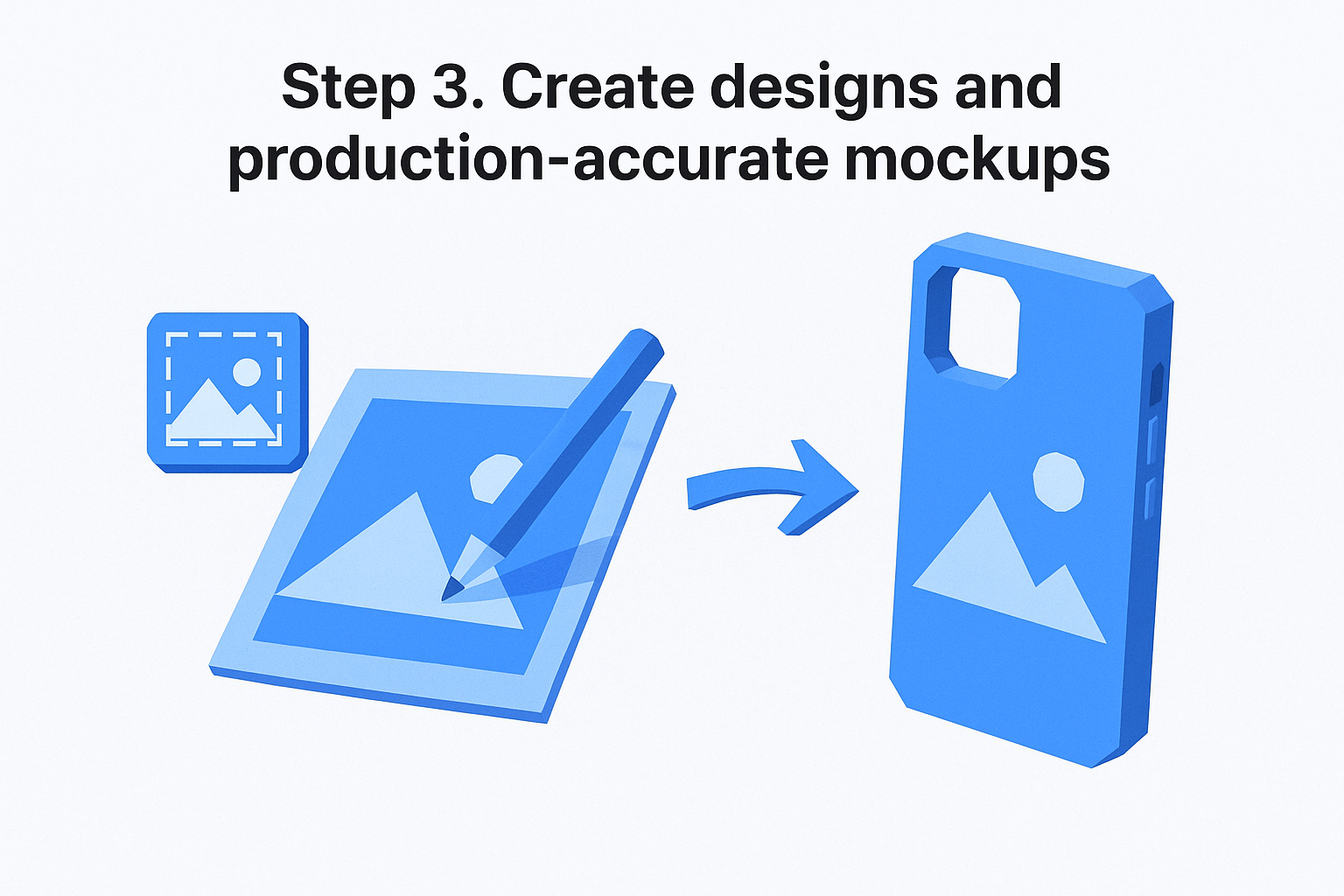
Step 3. Create designs and production-accurate mockups
Design quality and mockup accuracy separate profitable POD sellers from those who quit after three months of refunds. When you're figuring out how to start a print on demand business, this step demands more attention than most beginners give it. Your design needs to print clearly at the required resolution, and your mockup needs to show exactly what ships, not an aspirational version that looks good but misrepresents the final product. Customers buy based on what they see in your listing. If the actual product doesn't match, you've purchased a one-star review.
Design file specifications and technical requirements
Start with your supplier's exact design template and requirements. Phone case designs typically need 300 DPI resolution at the printed dimensions (usually 2800x5000 pixels for full-wrap cases). T-shirt designs require similar resolution but different canvas dimensions based on print area. Download the template file from your supplier's design tool, then build your design as a separate layer above the template guides.
File format matters more than you think:
- Export as PNG with transparent background for products where the base color shows through (phone cases, apparel)
- Use CMYK color mode if your supplier specifies it (most POD uses RGB, but verify)
- Keep design elements at least 0.25 inches from all edges to account for print bleed and manufacturing variance
- Save your working file as PSD or AI so you can edit later without rebuilding from scratch
Test your design on the actual product before you list it. Order a sample with your design applied, not just a blank base product. Check if fine text remains legible, if gradients print smoothly, and if colors match your screen preview. Designs that look sharp on your monitor often reveal compression artifacts or color shifts when printed on physical materials.
Why generic mockups cost you sales
Generic mockup templates from free stock sites show products that don't exist. The camera cutout placement is wrong, the case thickness doesn't match your supplier's specs, and the finish (matte versus glossy) contradicts what ships. You publish a listing with these mockups, the customer orders based on what they see, and the product arrives different. That gap between expectation and reality is where reviews die and return rates climb.
Production-accurate mockups use templates built from real manufactured products. For phone cases, this means mockups that reflect your supplier's exact edge profile, button placement, and MagSafe ring positioning. The difference isn't aesthetic, it's operational. Accurate mockups reduce returns, improve review scores, and let you price confidently because you're not quietly absorbing a 12% refund rate as the cost of doing business.
Mockup accuracy isn't a nice-to-have feature. It's the only way to make your listing a promise you can keep.
Source mockups from providers who specialize in your product category and verify they match your supplier's current manufacturing specs. Specifications change when suppliers update tooling or switch factories. Mockups created two years ago for an iPhone 14 case won't accurately represent today's iPhone 16 case from the same supplier.
Step 4. Choose where to sell and set up your store
Your sales platform determines your customer base, fee structure, and how much control you have over branding and pricing. When you're learning how to start a print on demand business, this decision shapes your entire operational workflow. You can start on one platform and expand later, but your first choice should align with where your target niche already shops and which fee model fits your margin calculations. Each platform handles POD integrations differently, and setup complexity ranges from 20 minutes to two full days depending on your choice.
Platform comparison and selection criteria
Etsy works best for niche products and design-driven buyers who expect handmade aesthetics and personalization options. You pay $0.20 per listing, 6.5% transaction fee, and 3% payment processing. The platform brings built-in traffic but also built-in competition. Listing optimization matters more here than on any other platform because search visibility directly controls sales volume.
Shopify gives you full control over branding, pricing, and customer data but requires you to drive your own traffic through ads or social media. Monthly plans start at $39, and you'll pay 2.9% + 30¢ per transaction. POD apps like Printful integrate directly, automating order routing. Choose Shopify if you're building a standalone brand and have a marketing budget to support customer acquisition.
Amazon reaches the largest audience but enforces strict compliance rules around product claims, keywords, and imagery. You'll use Merch by Amazon for apparel or Amazon Handmade for other POD products. Competition is price-driven, and your mockup quality becomes your only differentiation tool. Margins compress faster here than anywhere else, but volume can compensate if you optimize listings correctly.
Platform fees eat 10-15% of revenue before you've paid for ads or product costs. Factor this into your breakeven calculations before you commit.
Store setup checklist
Open your chosen platform account and complete these steps in order:
Basic store configuration:
- Upload profile photo and banner (even placeholder versions, update later)
- Write store description with your niche focus clearly stated
- Set up payment processing (link bank account and verify identity)
- Configure shipping settings (your supplier handles fulfillment, but you control displayed timeframes)
- Enable tax collection if required in your jurisdiction
Integration and product setup:
- Connect your POD supplier account through the platform's app marketplace or API
- Import your first 10-15 products with completed designs and accurate mockups
- Write product titles using your researched keywords (front-load the most important terms)
- Add product descriptions that explain material, fit, and care instructions
- Set pricing based on your margin targets plus platform fees
Test your checkout process by placing a sample order yourself. Confirm the supplier receives the order details correctly and ships to the address you provided. Fix integration issues now, not after your first real customer complains.
Step 5. Price, launch, and market your first 30 days
Pricing determines profitability, but launch strategy determines whether you'll have any sales to measure. The final step in understanding how to start a print on demand business is executing a 30-day launch plan that tests your product market fit, gathers reviews, and identifies which designs actually convert. You're not optimizing for viral growth in month one. You're optimizing for data: which products sell, which mockups get clicks, and which price points customers accept without hesitation.
Calculate your pricing with real margin math
Start with your cost structure per product and work backwards to your retail price. Take your supplier's base cost, add shipping, add platform fees (transaction + listing), then multiply by 2.5 to 3 for your starting price. A phone case that costs you $12 in total fees should retail at $30 to $36. Test both ends of that range across different products to see where conversion rates stay strong.
Build a pricing spreadsheet with these columns:
| Product | Supplier Cost | Shipping | Platform Fees | Total Cost | 2.5x Price | 3x Price | Competitor Average |
|---|---|---|---|---|---|---|---|
| iPhone 16 Case | $8.50 | $2.75 | $2.15 | $13.40 | $33.50 | $40.20 | $34.99 |
Adjust your retail price based on competitor positioning and perceived value. If your mockups show better accuracy than competitors charging $35, you can price at $38 without resistance. Customers pay for confidence that the product matches the listing.
Execute a structured first month
Your first 30 days focus on visibility and review accumulation, not profit maximization. Launch with 15 to 20 products across your niche, publish listings with optimized titles and accurate mockups, then drive initial traffic through these tactics:
Week 1-2: Organic platform optimization
- Refresh your listings daily by updating tags or descriptions (signals activity to platform algorithms)
- Share your top 5 products in relevant niche communities with genuine participation, not spam
- Enable your platform's promoted listings or ads at $3 to $5 daily budget
Week 3-4: Paid acquisition testing
- Run Facebook or Instagram ads targeting your niche with $10 daily budget split across 3 design variations
- Track which designs generate clicks and which convert to sales
- Double spend on winners, pause losers after 100 impressions with zero engagement
Your goal in month one is 10 to 15 sales and 3 to 5 verified reviews, not breaking even on ad spend.
Request reviews from every customer who receives their order without issues. Most platforms automate this, but a personal follow-up email increases response rates by 40%. Use review feedback to identify mockup accuracy problems or product quality concerns before you scale your catalog further.
Next steps
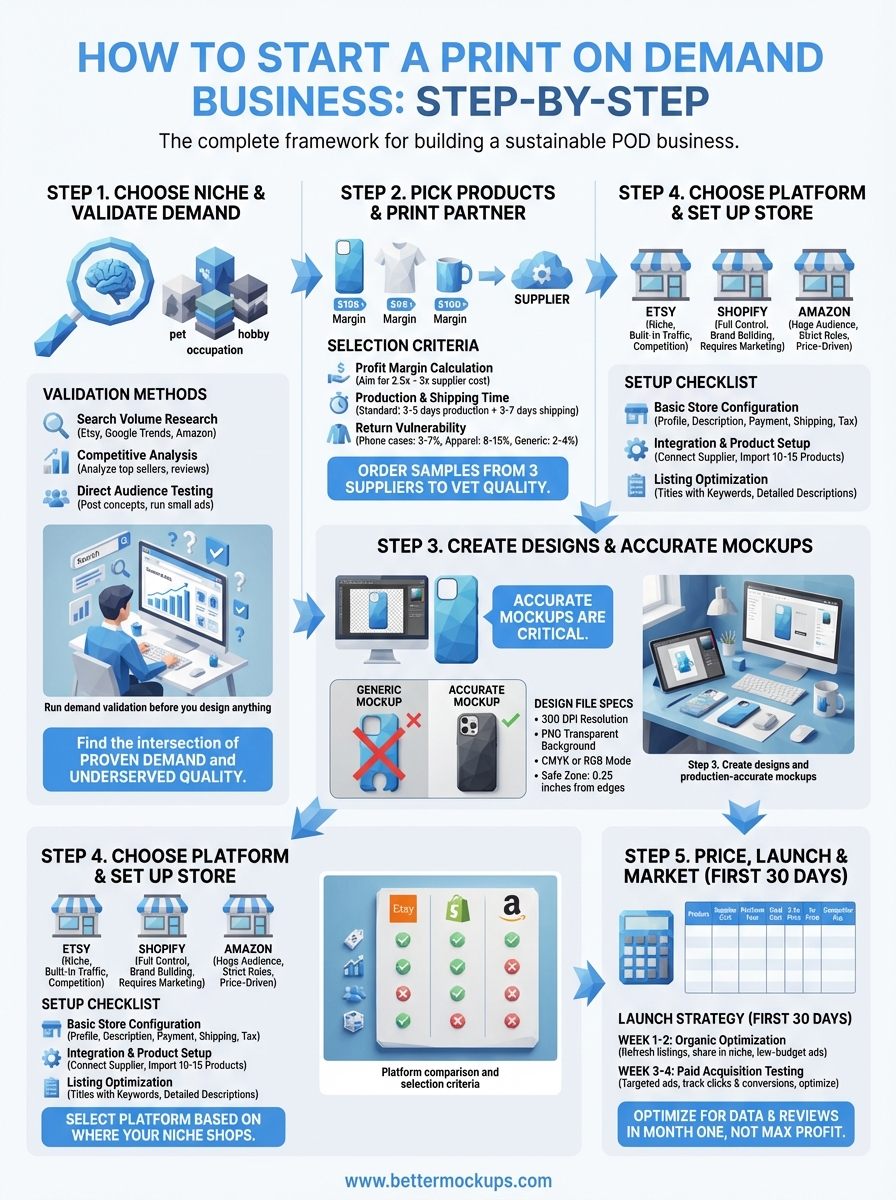
You now have the complete framework for understanding how to start a print on demand business: validated niche, vetted supplier, accurate designs, optimized listings, and a launch strategy that prioritizes data over assumptions. Your first 90 days focus on execution, not perfection. Publish your initial catalog, ship your first 20 orders, collect feedback, and iterate based on what actually converts versus what you hoped would work.
The operational detail most sellers underestimate is mockup accuracy. Generic templates create a visual promise your supplier can't keep, which turns into refunds and damaged reviews. If you're selling phone cases, start with mockups built to match your manufacturer's exact specifications. Production-accurate phone case mockups eliminate the gap between what customers see and what they receive, which means your reviews become assets instead of liabilities.
Treat your first six months as paid market research. Track which designs sell, which platforms deliver the best margins, and where your customer acquisition costs stay sustainable. Scale what works, cut what doesn't, and remember that most successful POD sellers didn't find their winning product on the first attempt.


