

Finding the right way to present your tech accessories online can feel overwhelming. Today’s marketplace pushes sellers to stand out, whether you’re choosing dropshipping or print on demand. Understanding the differences between these models helps you decide whether you want fast shipping or total design control. Explore how your decision impacts product images, brand loyalty, and sales for tech accessories from phone cases to AirPods covers.
Table of Contents
- Dropshipping And Print On Demand Explained
- Key Differences Between The Models
- Why This Matters For Tech Accessories
- Key Differences For Tech Accessories Sellers
- Customization And Brand Control
- Product Variety And Availability
- Shipping Speed
- Visual Presentation Matters Most
- Pros, Cons, And Common Challenges
- Dropshipping Advantages
- Dropshipping Challenges
- Print On Demand Advantages
- Print On Demand Challenges
- Presentation Challenges Both Face
- Boosting Sales With Quality Phone Case Mockups
- Why Mockups Matter More Than You Think
- The Problem With Generic Photos
- BetterMockups Advantage
- Mockups For Both Business Models
- How To Choose The Best Model For You
- Print On Demand Is Right If You…
- Dropshipping Is Right If You…
- The Decision Framework
- Consider Hybrid Approaches
Key Takeaways
| Point | Details |
|---|---|
| Customization vs. Selection | Print on Demand offers unique, customizable products, while dropshipping provides a wide range of pre-made items. |
| Fulfillment Speed | Dropshipping generally ensures faster shipping due to existing inventory, whereas Print on Demand involves longer production times. |
| Brand Control | Print on Demand allows for complete brand creativity, while dropshipping limits you to the supplier’s catalog. |
| Risk and Investment | Both models eliminate inventory risk, but dropshipping requires no upfront stock, whereas Print on Demand costs are incurred per order. |
Dropshipping and Print on Demand Explained
These two business models sound similar but work differently. Understanding their distinct approaches helps you choose which fits your tech accessory store.
Dropshipping is a fulfillment method where you sell products without holding inventory. Your supplier ships orders directly to customers using their warehouse and logistics. You act as the middleman, handling marketing and customer service while someone else manages storage and shipping.
Print on Demand is production-based. Items are manufactured only after a customer orders them, typically with custom designs applied. This means no pre-made inventory sitting in warehouses waiting to sell.
Key Differences Between the Models
These two models serve different business goals. Here’s how they compare:
- Customization: Print on Demand offers unlimited design freedom; dropshipping typically sells pre-made products
- Inventory risk: Dropshipping requires zero upfront stock; Print on Demand requires zero inventory investment but relies on per-unit production
- Production timing: Dropshipping ships existing stock immediately; Print on Demand manufactures then ships after each order
- Brand control: Print on Demand lets you design completely custom products; dropshipping limits you to supplier catalogs
While Print-on-demand and dropshipping are distinct models, some businesses blur these lines by outsourcing both production and fulfillment to third-party vendors.
Why This Matters for Tech Accessories
Tech accessories like phone cases, AirPods covers, and screen protectors have competitive markets. Product visuals determine whether customers buy or skip your listing.
With Print on Demand, you control the final product appearance and can create designs that stand out. With dropshipping, you depend on supplier quality and inventory availability.
Accurate product mockups matter more than ever for both models. Using production-grade mockups like those from BetterMockups ensures your product images match what customers receive, building trust immediately.
The right business model depends on whether you prioritize design control and customization or fast fulfillment with minimal risk.
For tech accessories specifically, Print on Demand lets you test trending designs without bulk inventory commitments. Dropshipping lets you offer popular products fast if you find reliable suppliers.
Pro tip: Whichever model you choose, invest in professional product mockups early. Customers judge tech accessories by appearance first, so accurate mockups of phone cases, protective covers, and protective skins directly impact your conversion rates.
The table below summarizes how dropshipping and print on demand impact critical aspects of a tech accessory business:
| Business Aspect | Dropshipping Impact | Print on Demand Impact |
|---|---|---|
| Brand Identity | Generic, supplier-driven | Unique, design-driven |
| Product Selection | Hundreds, instantly available | Fewer, limited by custom design |
| Inventory Investment | None, supplier holds stock | None, produced per order |
| Quality Control | Hard to monitor | Easier, direct design oversight |
| Speed to Market | Fast, ready-to-ship inventory | Slower, requires production time |
Key Differences for Tech Accessories Sellers
Tech accessories are competitive. Phone cases, protective covers, and AirPods cases flood every marketplace. Your choice between Print on Demand and dropshipping directly determines how you compete.
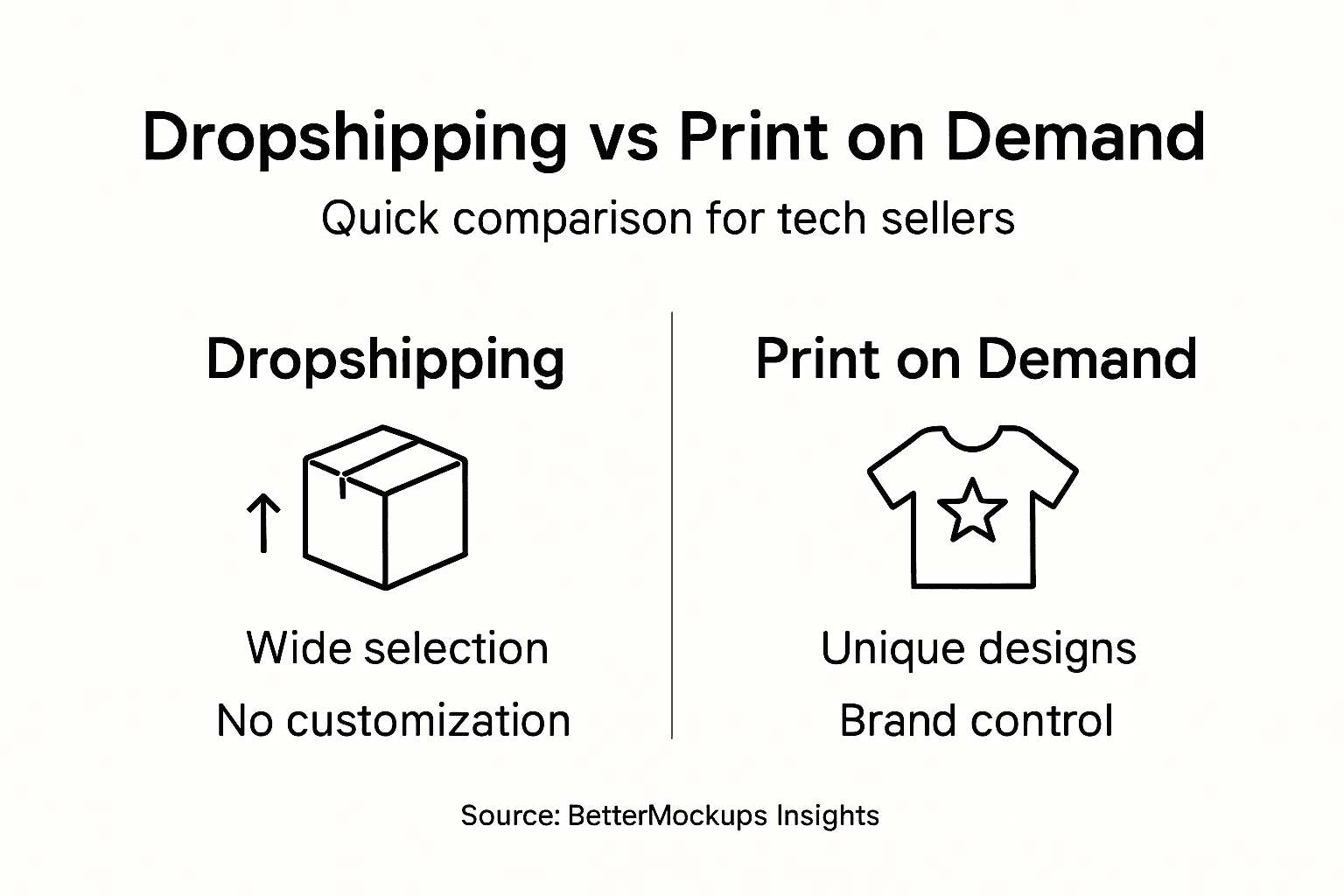
The core difference comes down to customization versus selection. Print-on-demand allows custom designs, letting you create unique phone cases and branded accessories that reflect your aesthetic. Dropshipping gives you access to thousands of pre-made products, but they look identical to what your competitors sell.
Customization and Brand Control
With Print on Demand, you own your product design. You create phone cases with specific color combinations, patterns, or artwork that customers can’t find elsewhere. This builds brand loyalty because customers buy your unique vision, not generic inventory.
Dropshipping limits you to supplier catalogs. If ten other sellers offer the same phone case from the same supplier, price becomes your only differentiator. You’ll constantly compete on cost, not quality or creativity.
- Print on Demand: Design complete control, unlimited variations, custom branding
- Dropshipping: Pre-made products, limited design options, generic inventory
Product Variety and Availability
Dropshipping wins on selection. You can list hundreds of phone cases, screen protectors, and chargers instantly without inventory risk. New products appear constantly from suppliers.
Print on Demand requires you to design each product variant. You might offer five phone case designs instead of five hundred pre-made models.
Shipping Speed
Dropshipping ships faster because inventory exists in warehouses. Orders often arrive within 3-7 days from supplier locations.
Print on Demand manufactures then ships, adding 2-5 days to production. Total delivery typically takes 7-12 days depending on production capacity and shipping method.
Speed matters less than customer expectations. Print on Demand customers understand manufacturing takes time; dropshipping customers expect warehouse-speed delivery.
Visual Presentation Matters Most
For both models, product images determine conversions. Tech accessories rely on accurate mockups showing how the case fits, how designs look applied, and overall quality.
Using professional phone case mockups ensures your images match what customers receive. BetterMockups provides production-grade mockups in image, PSD, and video formats specifically designed for tech accessories.
Pro tip: If you’re testing whether to pursue Print on Demand or dropshipping, start with a few designs using professional mockups to gauge demand, then scale the winning products with your chosen model.
Pros, Cons, and Common Challenges
Both models eliminate inventory risk, but they create different problems. Understanding what each brings helps you avoid costly mistakes.
Dropshipping Advantages
Dropshipping offers fast entry into selling tech accessories. You launch with zero inventory investment, test products quickly, and scale without warehouse costs.
- Low startup costs: No upfront product purchases or storage expenses
- Wide selection: Access thousands of tech accessories from suppliers
- Fast testing: Launch new products in days, not months
- Scalability: Grow sales without managing inventory logistics
Dropshipping Challenges
Dropshipping struggles with supplier reliability and intense competition. You depend entirely on third-party suppliers for quality, shipping speed, and product accuracy. If your supplier ships a defective phone case, your customer blames you.
Competition crushes profit margins. When hundreds of sellers offer identical products, you compete on price alone, eroding profitability. Quality control remains difficult since you never touch the product before customers receive it.
- Supplier dependency: Quality issues reflect on your brand
- Intense competition: Price wars reduce profit margins significantly
- Quality concerns: Limited oversight of manufacturing and fulfillment
- No differentiation: Same products as competitors’ catalogs
Print on Demand Advantages
Print on Demand lets you build a distinct brand. Custom designs create products customers can’t find elsewhere, fostering loyalty and stronger margins.
You test designs risk-free. No bulk inventory commitment means trying new designs costs only the per-unit production fee. Design variations test market demand before scaling.
- Complete customization: Design unique products that stand out
- Risk-free testing: Launch designs without bulk inventory
- Strong branding: Build loyal customers around your aesthetic
- Higher margins: Custom products command premium pricing
Print on Demand Challenges
Longer fulfillment times frustrate customers expecting fast delivery. Manufacturing adds 2-5 days to production timelines. Profit margins also shrink with per-unit production costs higher than dropshipping wholesale pricing.
You’re limited to products that support printing or customization. Not every tech accessory works with Print on Demand methods. Quality depends on your supplier’s printing capabilities and consistency.
The real challenge in Print on Demand isn’t the model itself—it’s finding a reliable supplier whose quality matches your brand standards.
- Longer lead times: Manufacturing delays total delivery 7-12 days
- Lower margins: Per-unit costs reduce profit per sale
- Limited product types: Only customizable items work well
- Quality dependency: Supplier’s print quality affects brand perception
Presentation Challenges Both Face
Both models fail without professional product visuals. Inaccurate mockups showing phone cases don’t fit right or colors look wrong kill conversions before customers add items to cart.
BetterMockups solves this with production-grade phone case mockups that match actual product specifications. Your mockups show exactly what customers receive, eliminating surprise disappointments.
Pro tip: Start by identifying your biggest pain point—if quality control worries you, choose Print on Demand for direct supplier relationships; if speed matters most, optimize dropshipping with vetted suppliers and professional product mockups.
Boosting Sales With Quality Phone Case Mockups
Product images sell phone cases. Customers decide within seconds whether your design looks professional or amateur. Mockups determine conversion rates before customers even read descriptions.
A blurry photo or poorly fitted case image loses sales instantly. Buyers can’t visualize how designs look on actual phones. They leave your listing and buy from competitors showing clear, professional mockups.
Why Mockups Matter More Than You Think
Phone case mockups show realistic product presentation. They display exact design placement, color accuracy, and how cases fit different phone models. Customers see precisely what they’ll receive before purchasing.
Mockups build trust. When your product images match actual inventory quality, customers feel confident buying. Returns drop significantly when mockup accuracy matches delivered products.
- Display design placement accurately on phone surfaces
- Show realistic lighting and shadows for authentic appearance
- Demonstrate fit and protection features clearly
- Build customer confidence before purchase
- Reduce return rates through accurate representation
The Problem With Generic Photos
Regular photos require expensive equipment, professional photographers, and multiple iterations. You need different angles for each case design, each phone model, and each color variation.
This becomes unsustainable at scale. Testing five designs across eight phone models means forty photo shoots. Professional phone case mockups eliminate this bottleneck completely.
BetterMockups Advantage
BetterMockups provides production-grade phone case mockups built using the same 3D models manufacturers use. Mockups match actual product specifications precisely, ensuring your images represent real inventory.
Available in multiple formats for maximum flexibility:
- Image files for product listings and marketplace posts
- PSD templates for custom design adjustments
- Video mockups for animated product demonstrations
- 3D models for advanced customization needs
These mockups work for all phone case types including snap cases, tough cases, slim cases, and specialty designs. Your mockups instantly look professional without hiring photographers or renting studios.
Quality mockups convert browsers into buyers by showing exactly what customers receive.
Mockups for Both Business Models
Whether you use dropshipping or Print on Demand, mockups solve your presentation challenge. Dropshipping sellers need mockups to showcase pre-made inventory attractively. Print on Demand sellers need mockups demonstrating custom design placement and fit.
BetterMockups accommodates both. Create professional listings in hours instead of weeks. Update mockups instantly when introducing new designs or colors.
Pro tip: Create mockups for your top 5 performing designs first, then expand to slower sellers; this focuses your effort on products customers already want while building your mockup library cost-effectively.
How to Choose the Best Model for You
Neither model works universally. Your choice depends on what matters most to your business. Starting with the right foundation prevents costly pivots later.
Ask yourself three critical questions: Do you want creative control? How quickly do you need to fulfill orders? What profit margins can you sustain?
Print on Demand Is Right If You…
Print-on-demand offers higher profit margins and brand uniqueness through customization but slower fulfillment. Choose this model when brand identity matters more than speed.
You’re suited for Print on Demand if you:
- Design unique products that reflect your creative vision
- Value brand differentiation over competing on price
- Want to test designs without bulk inventory investment
- Target niche audiences willing to wait for custom products
- Can manage supplier relationships for print quality consistency
Designers, artists, and brand-focused entrepreneurs thrive here. You build customer loyalty around your aesthetic, not price wars.
Dropshipping Is Right If You…
Dropshipping suits entrepreneurs prioritizing speed and volume. You want access to thousands of products immediately without design responsibilities.
You’re suited for dropshipping if you:
- Prefer fast order fulfillment over design customization
- Want broad product selection to test what sells
- Focus on marketing and sales rather than product creation
- Target price-conscious customers buying established products
- Need quick market entry with minimal startup investment
If you’re strong at marketing but weak at design, dropshipping leverages your strengths. You find trending products, promote them aggressively, and scale quickly.
The Decision Framework
Evaluate yourself honestly against these factors:
- Creative ability: Can you design appealing phone cases or accessories?
- Time patience: Will customers accept 7-12 day delivery for Print on Demand?
- Capital available: Can you invest in supplier relationships and quality control?
- Target market: Are your customers designers or price-hunters?
- Competitive advantage: Do you stand out through design or marketing?
Your choice determines whether you compete on uniqueness or volume—pick the path matching your actual strengths.
Consider Hybrid Approaches
You don’t have to pick one exclusively. Many successful sellers start with dropshipping to validate market demand, then introduce Print on Demand products for differentiation.
Others launch custom Print on Demand designs alongside dropshipped complementary products. Mix both models strategically once you understand your customer base and capabilities.
Pro tip: Start with one model for 30 days, track profit margins and fulfillment satisfaction carefully, then decide if switching or adding the other model makes sense for your specific business situation.
Here’s a quick guide to choosing the best model based on your business priorities:
| Priority | Best Model | Rationale |
|---|---|---|
| Brand Uniqueness | Print on Demand | Custom designs set you apart |
| Fast Shipping | Dropshipping | Pre-made stock ships quickly |
| High Profit Potential | Print on Demand | Unique products can command higher prices |
| Wide Product Range | Dropshipping | Access to many SKUs without design work |
| Minimal Upfront Effort | Dropshipping | No design or product development required |
Elevate Your Tech Accessory Business With Professional Mockups
Choosing between dropshipping and Print on Demand means deciding how to best present your unique product offerings and build customer trust. The article highlights common challenges like achieving stand-out customization, managing quality control, and overcoming stiff competition with generic product images. If you want to boost your tech accessories sales, accurate and photorealistic product visuals are vital for converting browsers into buyers.
BetterMockups specializes in premium phone case and tech accessory mockups designed to perfectly showcase your products in crisp detail. Whether you use dropshipping with ready-made catalogs or Print on Demand with custom designs, our mockups help you communicate quality and craftsmanship at a glance. Using our PSD and Canva templates, video mockups, and realistic presentations, you can build a stronger brand, reduce returns, and win customer confidence fast.
Explore our wide variety of customizable mockups, and bring your product visuals to life today.
Take the next step to outshine competitors and accelerate your sales with professionally crafted mockups tailored for tech accessories. Visit BetterMockups now to start transforming your product listings with visuals that sell.
Frequently Asked Questions
What is the main difference between dropshipping and print on demand?
Dropshipping involves selling pre-made products that a supplier ships directly to customers, while print on demand requires custom products to be manufactured only after a customer places an order.
How does customization differ between dropshipping and print on demand?
Print on demand allows for unlimited design freedom and unique branding for each product, whereas dropshipping typically restricts sellers to pre-made products with limited design options.
Which business model is better for reducing inventory risks?
Both dropshipping and print on demand eliminate the need for holding inventory upfront. However, dropshipping allows you to list a wide selection of existing products without any investment, while print on demand only produces items as orders come in, minimizing stock-related risks.
What factors should I consider when choosing between dropshipping and print on demand for tech accessories?
Consider your priorities: if brand uniqueness and customization are vital, go for print on demand. If you need fast shipping and a broad product selection, dropshipping may be the better choice.


