

Choosing the right fulfillment partner can make or break your POD business. Gelato print on demand has positioned itself as a global fulfillment network with local production in 30+ countries, promising faster shipping and lower carbon footprints. But does it actually deliver for sellers running phone case and accessory shops on Etsy, Shopify, or Amazon? That depends on your product catalog needs and how well Gelato's offerings align with your specific niche.
At Bettermockups, we work with POD sellers who care about accuracy, not just in their mockups, but in every part of their fulfillment chain. The platform you choose affects everything from product quality to customer expectations, and a mismatch between your listings and delivered items creates the kind of review damage that's hard to recover from.
This guide breaks down Gelato's pricing structure, available products, setup process, and real-world performance so you can decide whether it belongs in your workflow. We'll cover what works, what doesn't, and where Gelato fits compared to alternatives like Printful or Printify.
What Gelato print on demand is and how it works
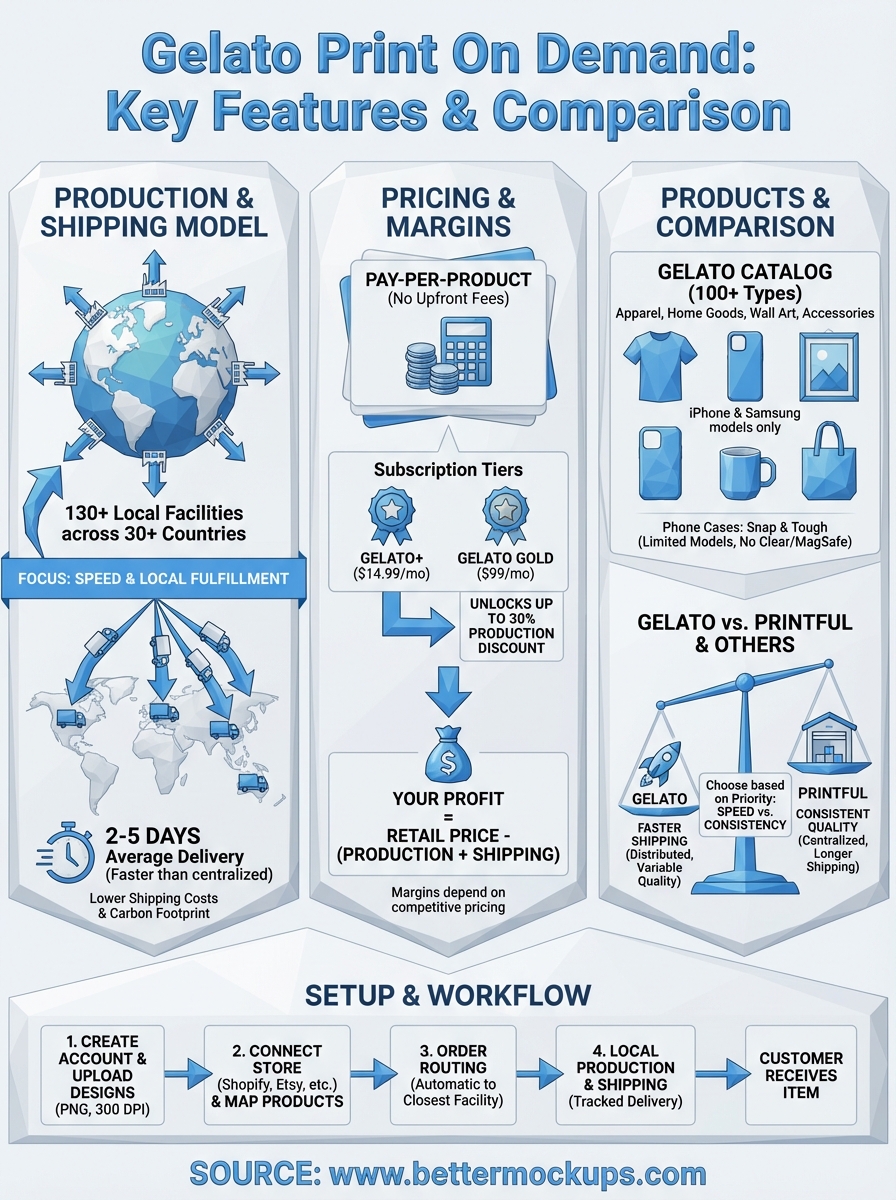
Gelato operates as a distributed production network rather than a traditional print-on-demand service with centralized warehouses. When a customer places an order through your store, Gelato routes that order to the geographically closest production facility in its network of 130+ partners across 32 countries. This local fulfillment model reduces shipping times and costs compared to sending every package from a single US or European warehouse.
How the production network operates
Your product files live in Gelato's system, not on physical inventory. When an order comes in, Gelato's software automatically selects the production partner based on the customer's delivery address, product availability, and current facility capacity. A customer in Sydney gets their order printed in Australia, while a Berlin customer's order ships from a German facility. This happens without any manual intervention on your part.

The network handles more than just apparel. Gelato produces wall art, mugs, phone cases, calendars, and other accessories alongside clothing items. Production partners follow Gelato's quality standards, though consistency can vary between facilities since you're dealing with multiple manufacturers rather than a single controlled environment.
Local production cuts average delivery times from 8-14 days down to 2-5 days for most orders.
Integration and order routing
Gelato connects to Shopify, Etsy, WooCommerce, and other platforms through direct API integrations. You install the app, map your designs to Gelato's product catalog, and the system handles order intake automatically. Every time someone buys from your store, Gelato receives the order details, processes payment, manufactures the item, and ships it with tracking information sent back to your platform.
You can also use Gelato's personalization engine to offer custom text, photo uploads, or design placement options directly in your product listings. The system passes those customization details to the production facility without requiring you to manually process each variant. This works for products like custom phone cases where customers upload their own images or text.
Gelato pricing, fees, and profit math
Gelato operates on a pay-per-product model with no monthly fees required to start. You pay the production cost plus shipping when an order comes through, and you set your own retail price on top of that. The gap between what you charge and what Gelato bills you is your profit margin. This pricing structure makes it easy to launch without upfront investment, but your margins depend entirely on how you price against their base costs.
Understanding base costs and subscription tiers
Free accounts access the full product catalog at standard wholesale rates. A basic phone case typically costs $8-12 to produce depending on the model and finish, while shipping adds $3-8 based on destination and speed. Gelato+ and Gelato Gold subscriptions ($14.99 and $99 per month) unlock discounted production rates of 10-30% per item, which matters if you're processing 50+ orders monthly. The subscription pays for itself once your volume hits the break-even threshold where the per-item savings exceed the monthly fee.
Production costs drop by up to 30% with paid plans, but only if your order volume justifies the monthly subscription cost.
Calculating your margins
You need to price above Gelato's combined production and shipping cost while staying competitive with similar listings. If a phone case costs you $10 to produce and $5 to ship domestically, your minimum price is $15 just to break even. Most sellers target 40-60% gross margins, which means pricing that same case at $25-37.50. Calculate backwards from your desired profit per sale, then test whether that price point converts in your market.
Gelato products and what to test first
Gelato's catalog covers more than 100 product types across apparel, home goods, wall art, and accessories. Phone cases sit in the accessories category alongside tote bags, mugs, and notebooks. The platform supports iPhone models from the 12 series onward and select Samsung Galaxy devices, with both snap cases and tough cases available. You won't find the same model coverage as specialized phone case fulfillment services, which limits your ability to target niche devices or older models still in circulation.
Phone case offerings and limitations
Gelato produces snap cases and tough cases for mainstream iPhone and Samsung models, but the catalog ends there. You can't order clear cases, MagSafe-compatible variants, or leather options through their network. Production partners handle standard finishes (glossy or matte) with full-wrap printing, but expect variability between facilities since multiple manufacturers fulfill these orders. This matters if you're building a brand that depends on consistent finish quality across repeat orders.
Test orders from different regions reveal production inconsistencies that customer reviews will eventually surface.
Start with sample orders from your target markets
Order your top three designs as samples to the regions where most of your customers live. If you sell primarily to US buyers, request shipments to East Coast and West Coast addresses to see which facilities handle your orders. Check camera cutout alignment, print sharpness, and case finish against your mockups before scaling. The $10-15 you spend per test case prevents the $200-500 you'd lose from negative reviews on a design that ships inaccurately across 50 orders.
Set up Gelato and connect your store
Creating a Gelato account takes less than five minutes, but the real setup work happens when you connect your store and map your designs to their product catalog. You need to configure your integration settings correctly from the start to avoid order routing errors that send the wrong designs to customers or duplicate orders across multiple fulfillment services if you're running other POD providers simultaneously.
Create your Gelato account and upload designs
Navigate to gelato.com and register with your business email address rather than a personal one. Gelato sends order confirmations, production updates, and facility notifications to this address, so keep it separate from your customer service inbox. After verification, upload your design files in PNG format at 300 DPI minimum with transparent backgrounds where applicable. The system accepts files up to 25MB, which handles most print-ready artwork without compression issues.
Add your designs to Gelato's library before connecting any stores. Tag each design with descriptive names that match your internal product SKUs so you can map them quickly during store integration. This organization prevents the confusion that happens when you're trying to link "floral_design_final_v3.png" to the right product variant three months after upload.
Link your Shopify or Etsy store
Install the Gelato app from your platform's marketplace (Shopify App Store or Etsy's integrations page). Grant the necessary permissions for order access and inventory management, then map your existing product listings to Gelato's catalog items. Select the phone case model, finish type, and design file for each variant you sell. Test the connection by placing a sample order through your store to confirm that gelato print on demand routes the order correctly and sends tracking information back to your platform automatically.
Always process a test order before announcing new products to verify the entire fulfillment chain works.
Gelato vs Printful and other POD options
Gelato's distributed production model sets it apart from Printful's centralized warehouse approach, but that difference cuts both ways. Printful manufactures everything in-house across a handful of facilities, giving you consistent quality control at the cost of longer international shipping times. Gelato prioritizes speed through local production, which means your orders ship faster but pass through different manufacturers with varying quality standards. Your choice depends on whether you value delivery speed over manufacturing consistency.
Network reach vs single-facility control
Gelato's 130+ production partners enable 2-5 day delivery in most markets, while Printful's model averages 7-10 days for international orders shipped from US or European hubs. You sacrifice some quality predictability with gelato print on demand because a customer in Tokyo and a customer in London receive products from completely different manufacturers. Printful's centralized production means every order meets the same specifications regardless of destination, which matters if your brand depends on repeatable quality across all markets.
Faster shipping doesn't matter if the product quality varies enough to generate negative reviews in specific regions.
Product catalog depth
Printful offers 40+ phone case models including MagSafe variants, clear cases, and older iPhone generations that Gelato doesn't support. Gelato counters with stronger wall art and home goods categories but falls short for sellers focused exclusively on mobile accessories. Test both platforms with sample orders if your product mix includes items where each service holds an advantage.
Next steps
Gelato print on demand works best for sellers who prioritize fast international shipping and need access to multiple product categories beyond phone cases. The distributed production model delivers speed at the cost of quality consistency, which means you'll need to test sample orders from your target markets before scaling any design. Order three samples from different regions, compare them against your mockups, and decide whether the variation between facilities falls within your brand's tolerance levels.
Accurate mockups matter more when you're using a multi-facility fulfillment network because your listings become the only consistent reference point customers have. Generic mockup templates won't match Gelato's actual case specs across different manufacturers, which creates the expectation mismatch that turns into refunds. Explore production-accurate phone case mockups built to real manufacturer specifications so your listings represent what customers actually receive, regardless of which facility fulfills the order.


