

If you're weighing print on demand vs dropshipping, you're really asking a deeper question: how much control do you want over what your customer actually receives? Both models let you sell products without holding inventory. Both can be launched with minimal upfront cost. But the way each one handles product quality, branding, and long-term profitability is fundamentally different, and that difference matters more than most comparison guides let on.
Print on demand lets you put your own designs on physical products, phone cases, apparel, mugs, and have them manufactured only when a customer orders. Dropshipping, by contrast, means you're reselling existing products from a supplier's catalog without ever touching them. One model gives you creative ownership. The other gives you speed. Neither is universally better, but one will almost certainly fit your goals and risk tolerance more naturally than the other.
At Bettermockups, we build production-accurate mockup templates for POD phone case sellers, the kind of sellers who chose print on demand specifically because they wanted to build a real brand, not just resell someone else's inventory. That perspective shapes how we think about this comparison. We've seen firsthand how the model you choose affects everything downstream, from your listing quality to your return rate. This article breaks down the key differences between print on demand and dropshipping, compares their profit structures and scalability, and helps you decide which path actually makes sense for the business you want to run.
What print on demand and dropshipping mean
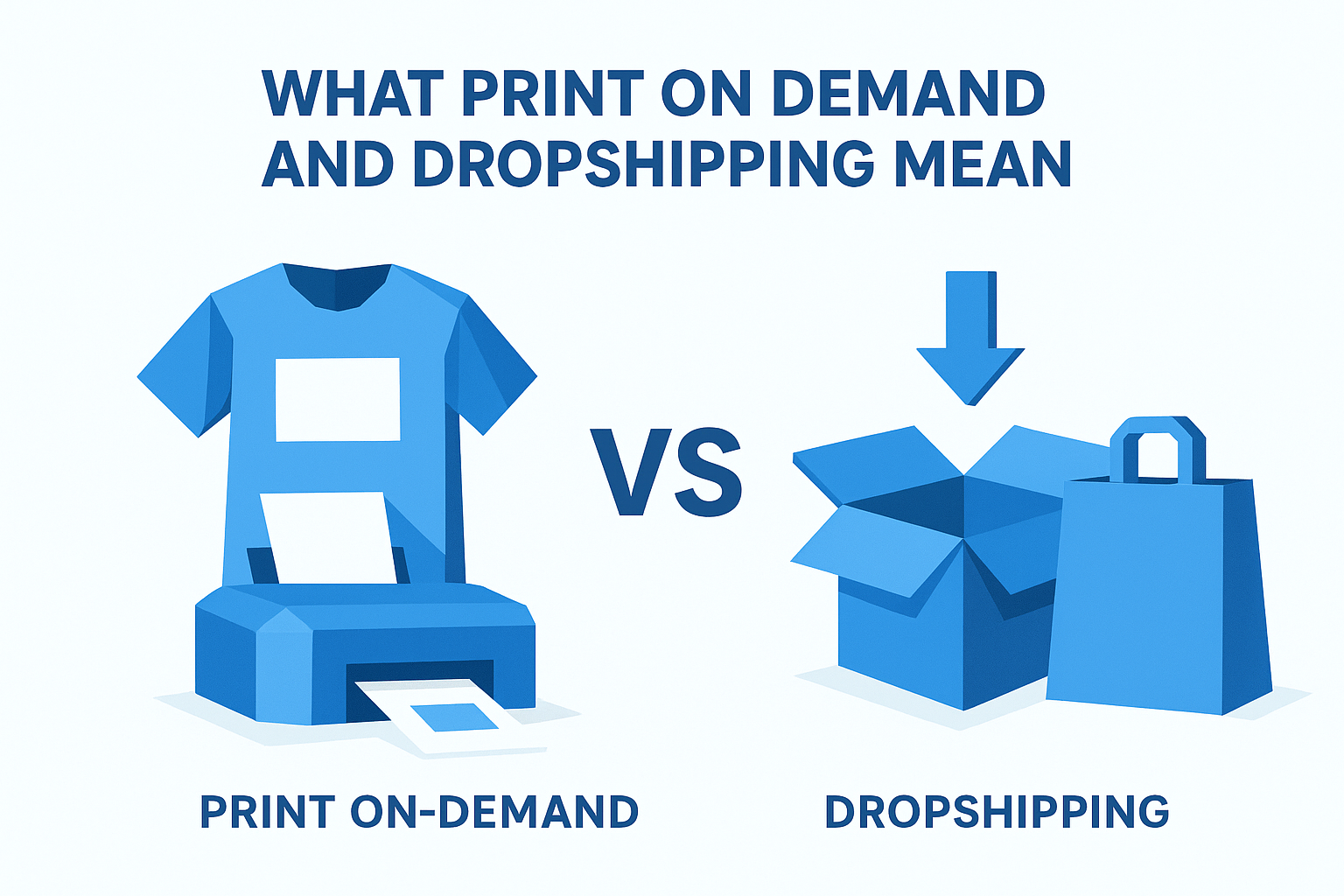
Both models fall under inventory-free selling, but they operate on completely different logic. Understanding exactly what each one is, not just loosely but in terms of who does what and when, makes the print on demand vs dropshipping comparison far more concrete and useful for making a real decision about your business.
What print on demand means
Print on demand (POD) is a fulfillment model where a product is manufactured only after a customer places an order. You create a design, upload it to a print provider's platform, and when someone buys, the provider prints and ships the item directly to your customer. You never hold stock, pay for production upfront, or handle the physical product. Common POD categories include apparel, phone cases, mugs, posters, and home goods.
What makes POD distinct is that the product is unique to your design. You're not reselling something that already exists in a supplier's catalog. The item that ships carries your artwork, your branding, and ideally matches the visual promise you made in your listing. That last point matters more than most sellers realize, especially in high-scrutiny categories like phone cases, where customers notice immediately if the camera cutout, finish, or edge profile doesn't match what they saw in the product photos.
A print on demand listing is only as trustworthy as the mockup behind it. If the mockup misrepresents the product, you haven't just lost a return; you've lost the review that should have followed.
What dropshipping means
Dropshipping is a retail fulfillment model where you sell products from a supplier's existing catalog without manufacturing anything yourself. You list a product in your store at a markup, and when a customer orders, your supplier ships it directly to them. You never see the item. Your role is to drive traffic, handle customer service, and manage the margin between what your supplier charges and what your customer pays.
The product in a dropshipping model already exists before you get involved. Someone else designed it, sourced the materials, and warehouses the inventory. Your role is closer to a reseller than a brand creator. That's not inherently a problem, but it fundamentally limits your leverage. You can't control the packaging, the product quality, or whether the photos you're using to sell accurately reflect what ships. If the supplier changes their product specifications or runs out of stock, your listings are affected immediately, whether you're aware of the change or not.
Where the two models overlap and where they split
Both models remove the need to pre-purchase or store inventory, which is why they're often grouped together. In both cases, the supplier ships directly to your customer, and your capital isn't tied up in product before a sale happens. For new sellers, that overlap makes both models feel like equally low-risk entry points.
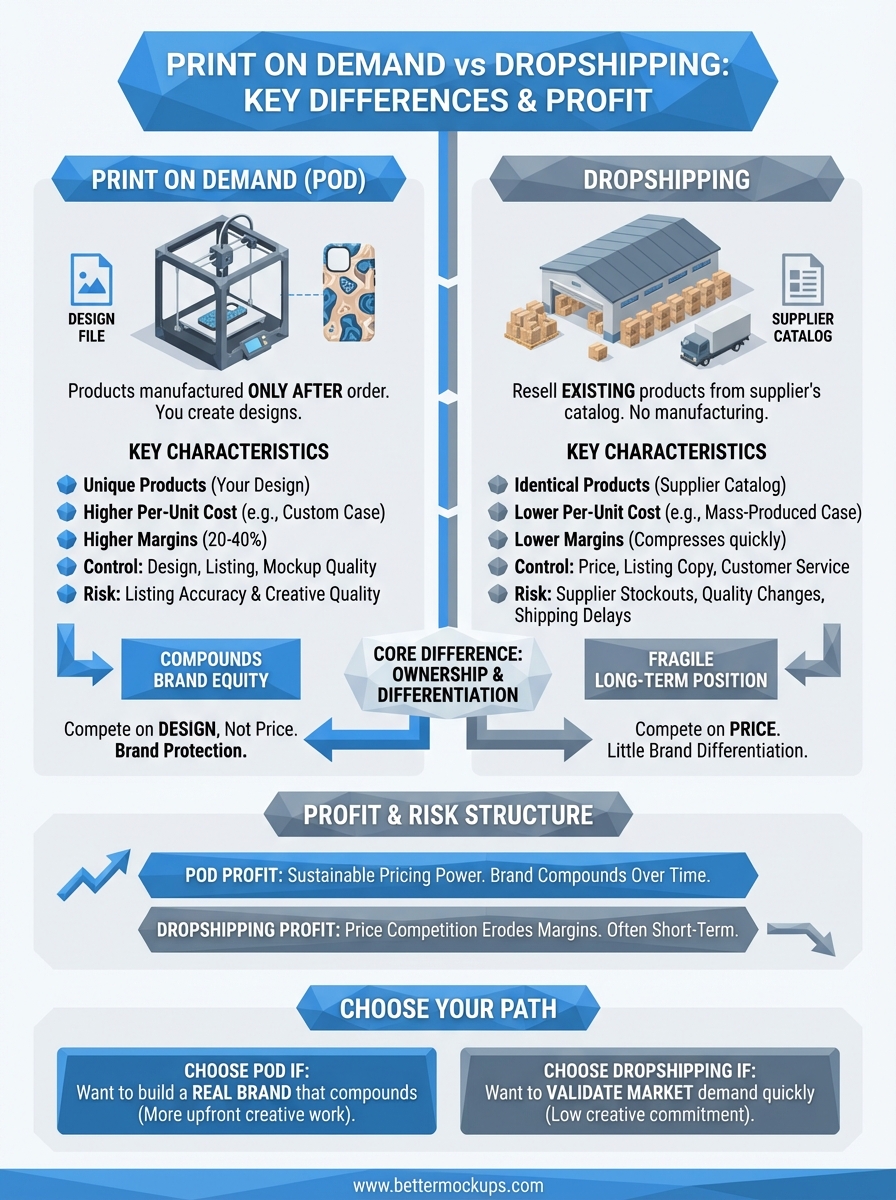
The split shows up in ownership and differentiation. With print on demand, you own the creative output. Your designs are yours. No other seller on any platform carries your exact product unless they've copied you directly. With dropshipping, you're selling the same catalog items that dozens or hundreds of other sellers also list. Competing on price becomes almost unavoidable because the product itself provides no differentiation from one storefront to the next. That structural constraint shapes everything downstream, including your margins, your brand equity, and your long-term position on any platform you operate on.
Why the difference matters for profit and risk
The choice between print on demand and dropshipping isn't just a fulfillment preference. It's a decision that sets your margin ceiling, your exposure to platform risk, and your ability to build anything that compounds over time. Most comparison guides treat this as a side note. It isn't. The structural economics of each model follow you into every listing, every pricing decision, and every customer interaction you have.
How margin structure differs between the two models
In print on demand, your cost per unit is higher because each item is manufactured individually. A custom phone case through a provider like Podbase will cost more per unit than a mass-produced case from a dropshipping catalog supplier. But what you're buying with that cost is a product tied to your brand and your creative work. Customers are paying for a design they can't find anywhere else, which gives you real pricing power. Margins in POD typically range from 20% to 40% depending on category, platform fees, and how well your listings convert.
In dropshipping, your per-unit cost can be lower, but so is your differentiation. Because dozens of sellers list the same product, price competition erodes margins quickly. A margin that looks healthy at launch often compresses within weeks once competing listings undercut you. The math works until it doesn't, and when it stops working, you have no brand equity to fall back on.
In print on demand vs dropshipping, the model with higher per-unit costs can still produce stronger long-term margins because it competes on design, not price.
Where risk concentrates in each model
Print on demand risk centers on listing accuracy and creative quality. If your mockup misrepresents the product, or your design doesn't translate well to the actual case, you absorb the consequence directly through refunds and reviews. That risk is real, but it's within your control. Better design decisions and accurate mockups reduce it substantially.
Dropshipping risk sits outside your direct control. Supplier stockouts, product specification changes, shipping delays, and quality inconsistency all affect your storefront without warning. Platform policies on dropshipping have also tightened across Etsy and Amazon, increasing the operational risk for sellers who rely on third-party catalog products. You're betting on a supplier relationship you don't own and can't fully verify.
How print on demand works in practice
Understanding print on demand at the process level makes the print on demand vs dropshipping comparison much more concrete. When you run a POD store, you're not just reselling items; you're creating a product from scratch every time someone places an order. That sequence, from design file to delivered package, runs entirely through your print provider, but every decision about what the product looks like starts with you.
From design to delivered product
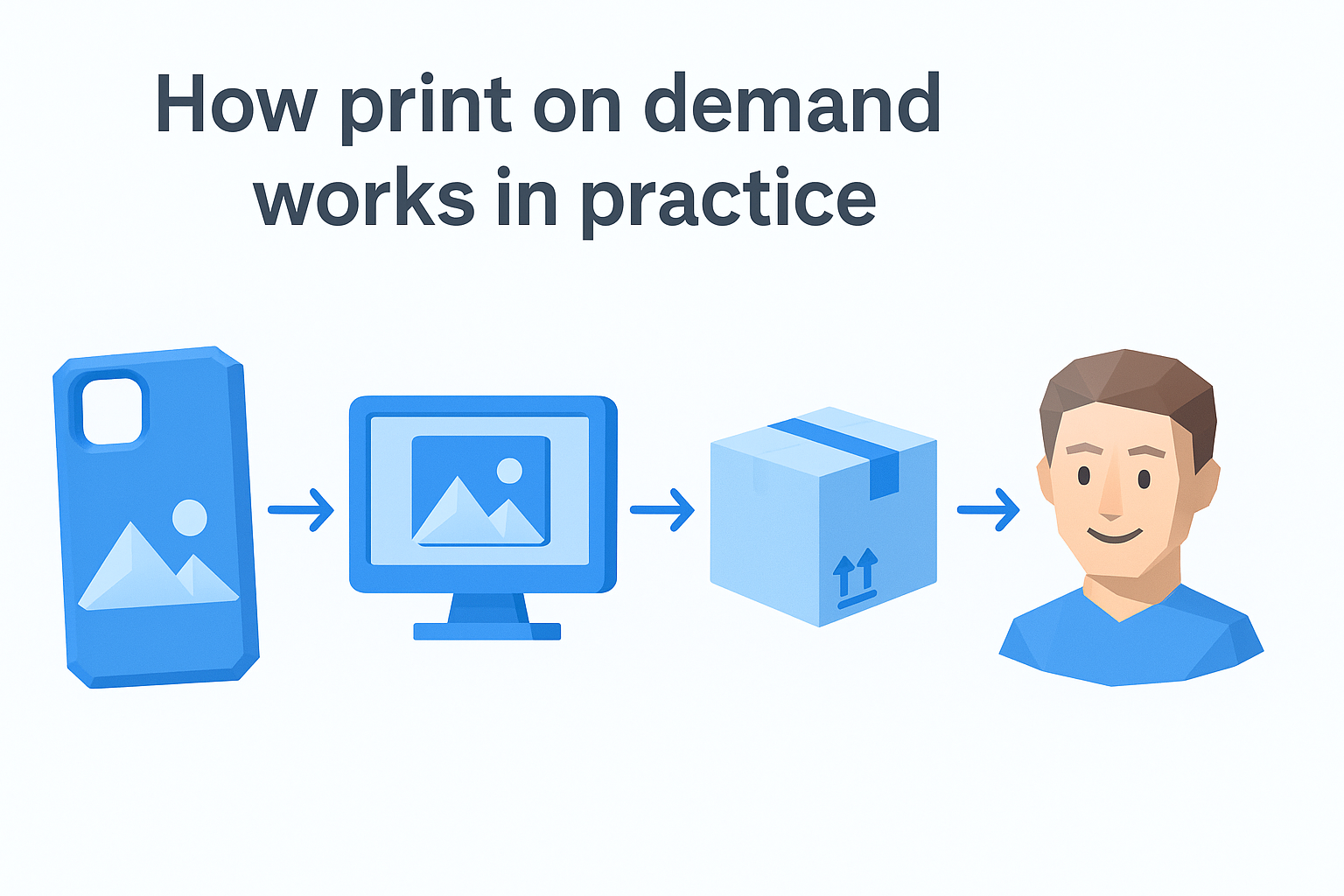
Your workflow starts with a design file, typically a high-resolution PNG or vector, that you upload to your print provider's platform. You place it on a product template, configure the listing, and publish it to your storefront. No units are manufactured until a customer buys. When the order comes in, it routes automatically to your provider, who prints, packs, and ships the item directly to your customer under your branding. You never touch the physical product.
Here's what the full sequence looks like in a standard POD phone case operation:
- Create and finalize your design file at the correct resolution and dimensions
- Upload it to your print provider (such as Podbase or Casestry) using their product template
- Set your retail price, which covers the provider's base cost plus your margin
- List the product on your storefront with mockup images representing the final item
- Receive an order; the provider automatically fulfills and ships to your customer
- Collect your margin after the provider's fee is deducted
The accuracy of your mockup at step four is what determines whether your customer's expectation matches what arrives at their door.
What you control and what you hand off
You control the design, the pricing, the listing presentation, and the mockup quality. Those are the variables that drive conversion and review outcomes. What you hand off is production and logistics. Your provider controls print quality, turnaround time, and packaging. That handoff is the operational core of POD, and it means your biggest leverage point is upstream, in how accurately your listing represents the product before the order is even placed.
If the mockup you publish shows the wrong camera cutout or a glossy finish when the case ships matte, no amount of good design work recovers that customer's trust. The product experience starts with the visual promise, not with the package.
How dropshipping works in practice
Dropshipping runs on a simpler operational premise than print on demand, but simpler doesn't mean easier to sustain. When you run a dropshipping store, you're sourcing products that already exist, marking them up, and routing orders to a supplier who ships directly to your customer. Your job is traffic and margin management, not product creation. Understanding how that plays out step by step reveals why the model works differently from POD in ways that matter for your long-term business.
From supplier catalog to customer door
Your process starts before a single sale happens. You browse a supplier's catalog, pick products that look profitable, set a retail price above the supplier's cost, and list those products in your store. The product already exists in finished form before you ever get involved. When a customer orders, you forward that order to your supplier, either manually or through an automation tool, and they ship it directly to your customer. You collect the difference between your retail price and the supplier's price, minus any platform fees.
Here's the standard dropshipping sequence in practice:
- Browse a supplier catalog and identify products with acceptable margins
- List the product in your store using the supplier's photos and specifications
- Set your retail price above the supplier's base cost
- Receive an order and forward it to your supplier with the customer's shipping details
- Your supplier packs and ships the item directly to your customer
- Collect your margin after the supplier's fee and platform costs are deducted
The moment your supplier changes a product's specification, raises their price, or goes out of stock, every listing you built around that product is immediately affected.
What you control and what you don't
In a dropshipping operation, your control is limited to price, listing copy, and customer communication. You don't control product quality, packaging, shipping speed, or what actually arrives in your customer's hands. Those variables sit entirely with your supplier. If they substitute materials, ship a different variant, or slow down fulfillment, your reviews absorb the damage.
When you compare print on demand vs dropshipping on this dimension, the contrast is sharp. POD sellers own their creative output and carry real risk that they can actively manage. Dropshippers carry supplier-side risk that operates independently of any decision they make, which makes building consistent brand trust structurally harder over time.
Key differences that affect profitability
When you compare print on demand vs dropshipping side by side, the differences that matter most aren't the ones most sellers focus on upfront. It's not which model is easier to start. It's which model gives you sustainable pricing power, brand protection, and control over the variables that drive real profit over time. Three structural differences separate the two models in ways that show up directly in your bottom line.
Pricing power and competitive position
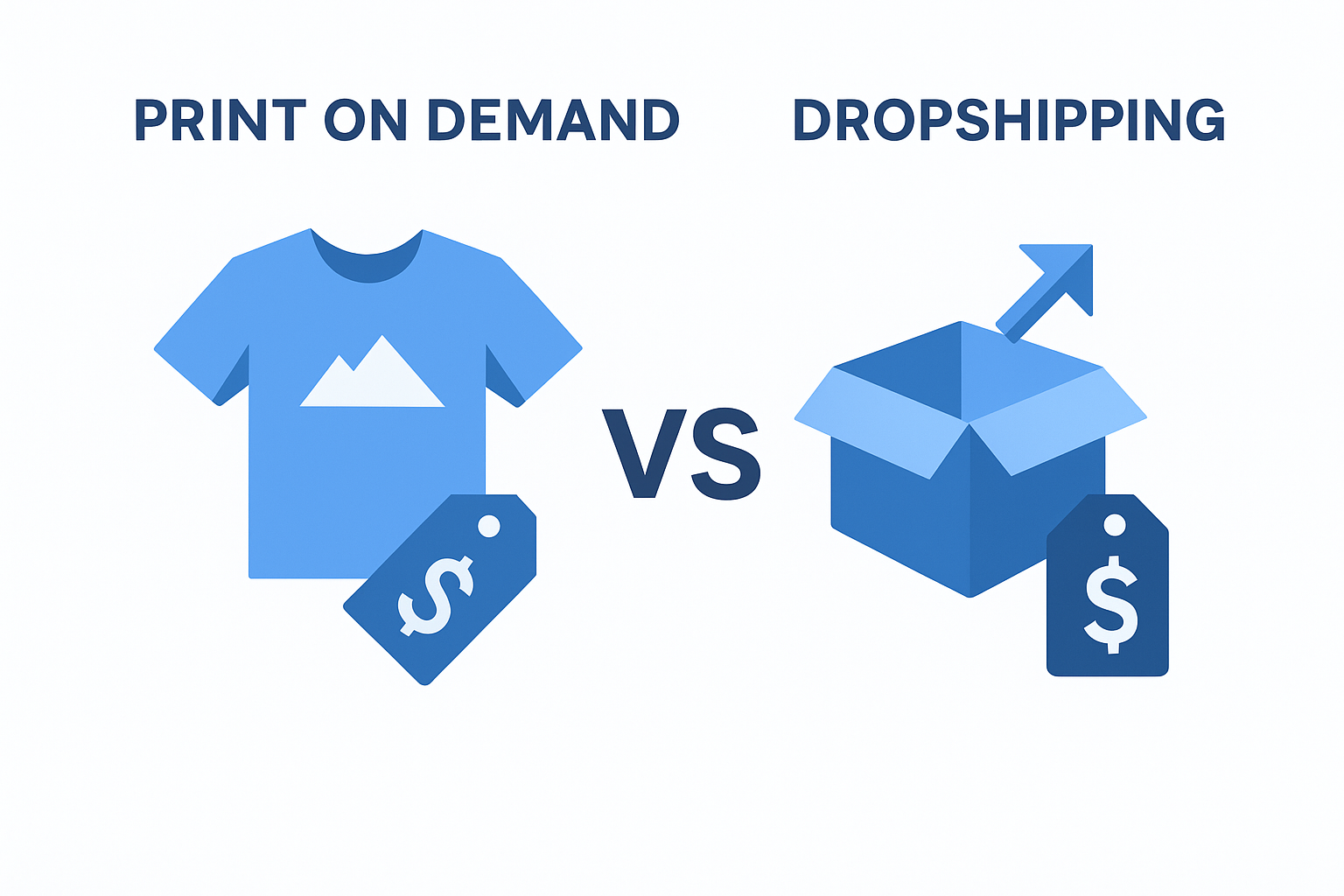
In print on demand, your design is the product. No other seller offers your exact item unless they've copied you, which means you're not competing on price by default. You set your retail price based on perceived value, not on what the lowest-priced competitor is charging for the same SKU. That pricing independence is one of POD's most undervalued financial advantages.
Dropshipping operates in the opposite dynamic. When multiple sellers list the same supplier product, price becomes the primary lever for differentiation. Customers can compare your listing directly against four others selling the identical item. Margins that look viable at launch compress quickly, and the only way to win on price is to earn less per sale.
Owning the product through design protects your margin in a way that reselling someone else's catalog product never can.
Returns, reviews, and long-term platform standing
Your return rate and review quality have a direct effect on profitability that goes beyond the cost of a single refund. On platforms like Etsy and Amazon, high return rates damage your listing's ranking, and negative reviews compound over time in ways that require significant new sales volume to offset.
Print on demand gives you direct control over the root cause of most returns: the gap between what the customer expected and what arrived. If your mockup accurately represents the product, your customers receive what they saw. That alignment is where BetterMockups invests its work, because production-accurate mockups reduce expectation gaps at the source.
Scalability and supplier dependency
Scaling a POD operation means adding more designs and listings. Your unit economics stay relatively stable because your provider relationship is consistent and your designs don't expire. Scaling a dropshipping operation means managing an expanding roster of supplier relationships, each carrying its own stockout risk, quality variability, and pricing instability. As your volume grows in dropshipping, your exposure to supplier-side disruption grows with it, not the other way around.
How to choose the right model for you
The right model depends on what you're actually trying to build. Print on demand vs dropshipping isn't a question with a single universal answer, but it does have a correct answer for your specific situation. The two variables that clarify the decision fastest are what kind of business you want running in two years and how much control over the customer experience matters to you right now.
Choose print on demand if you want a brand that compounds
If your goal is to build something with real brand identity and repeatable revenue, print on demand gives you the structural foundation to do that. Every design you publish is an asset that belongs to your store. Your listings don't become irrelevant because a supplier changed a product spec or a competitor undercut your price on an identical SKU. Over time, a library of strong, original designs builds a catalog that earns reviews, ranks in platform search, and creates customer loyalty that a dropshipping operation rarely achieves at the same depth.
The tradeoff is that POD demands more upfront creative work and more attention to listing quality. If your mockup doesn't accurately represent the product, every sale carries unnecessary risk instead of becoming a reliable step toward a five-star review. That gap is fixable, but fixing it requires treating listing presentation as seriously as the design work behind it. Sellers who get this right stop absorbing returns quietly and start building something that actually compounds.
Your mockup is the first moment your brand makes a promise to a customer. How accurately it represents the actual product determines whether that promise holds.
Choose dropshipping if you're validating a market first
Dropshipping makes sense when your primary goal is to test product demand before committing to a creative direction or a specific niche. Because you're not creating original designs, you can move through multiple product categories quickly without heavy time investment. If something sells, you learn what the market responds to without spending weeks on design files that don't convert.
The honest limit of dropshipping is that it rarely builds anything durable on its own. What you learn from it is valuable. What you build from it is fragile. Most sellers who rely on dropshipping as a long-term strategy eventually face margin compression and supplier instability with no brand equity to offset either problem. Treating it as a starting point rather than a destination is the most realistic way to use it well.
Final take
The print on demand vs dropshipping decision comes down to one honest question: do you want to build something you own, or test something quickly? Dropshipping gets you moving fast with low creative commitment, but the ceiling is low and the floor is fragile. Print on demand asks more from you upfront, but every design you publish becomes a real asset, one that earns reviews, builds brand recognition, and compounds over time without competing on price against identical listings.
The model you choose shapes every downstream decision you make, from how you price, to how you handle returns, to whether your listings hold up on Etsy or Amazon a year from now. If you're building a POD phone case business and you want your listings to actually deliver on their visual promise, accurate mockups are where that reliability starts. Browse production-accurate phone case mockup templates at BetterMockups and close the gap between what you publish and what your customer receives.


