

Teelaunch is one of the longer-running fulfillment providers in the Shopify ecosystem, and if you've searched for teelaunch print on demand, you're probably trying to figure out whether it's worth building on, or whether you've already outgrown it. The platform handles production and shipping for a range of products, including phone cases, and integrates directly with Shopify and Etsy, which makes it a common starting point for sellers scaling their catalogs.
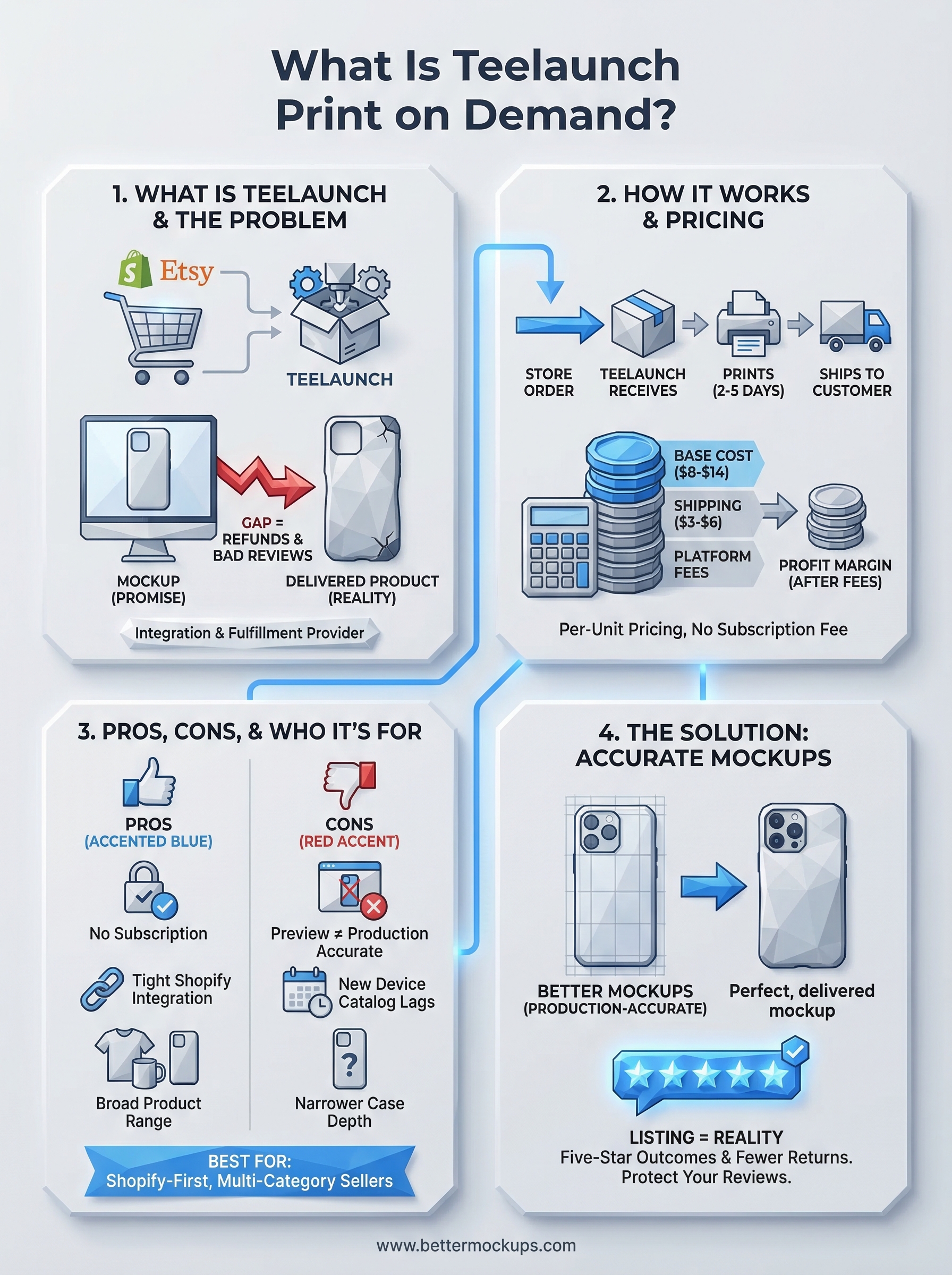
But here's where evaluation gets practical: a fulfillment partner is only as good as the accuracy of what you're promising customers. Teelaunch prints the case, your listing is what sells it. And if there's a gap between your mockup and the delivered product, that gap shows up as refunds, bad reviews, and eroded platform trust. That's exactly the problem we built Bettermockups to fix, production-accurate mockup templates matched to real manufacturer specs so your listings represent what actually ships.
This guide breaks down Teelaunch's pricing, product catalog, platform integrations, and the honest pros and cons, so you can decide whether it fits your POD operation and how to set your listings up for five-star outcomes from day one.
Why your print on demand partner matters
Your fulfillment partner controls three things that determine whether your store survives long-term: production quality, shipping reliability, and how well the finished product matches your listing. Most sellers pick a platform based on pricing alone and discover the real cost later, in the form of refunds, "item not as described" disputes, and review damage that takes months to recover from.
The cost of a bad product match
When a customer orders a phone case and receives something that looks different from your listing, they don't call it a fulfillment problem. They call it a dishonest listing. That distinction matters because platforms like Etsy and Amazon track seller metrics at the item level, and a pattern of accuracy complaints can suppress your listings before you even understand what's happening.
If your mockup doesn't match what ships, every sale is a gamble on whether the customer notices.
Why teelaunch print on demand is worth evaluating carefully
Choosing a provider like Teelaunch means committing your catalog, your customer relationships, and your brand reputation to their production standards. Switching later is expensive: you'll rebuild listings, re-mock products, and absorb ranking resets on every platform where you operate.
Getting the evaluation right the first time saves you that cost. That means looking past catalog size and base pricing to ask harder questions: Does this provider's product match what you're showing customers? Does their production consistency hold up across high-volume months? Those answers determine whether your five-star reviews become an asset or a liability, and that's the framing you should carry through the rest of this guide.
How Teelaunch print on demand works
Teelaunch operates as a fulfillment layer that sits between your store and your customer. Once you connect it to Shopify or Etsy, every order triggers automatically: the customer pays, Teelaunch receives the order, prints the product, and ships it directly to the buyer. You never touch inventory.
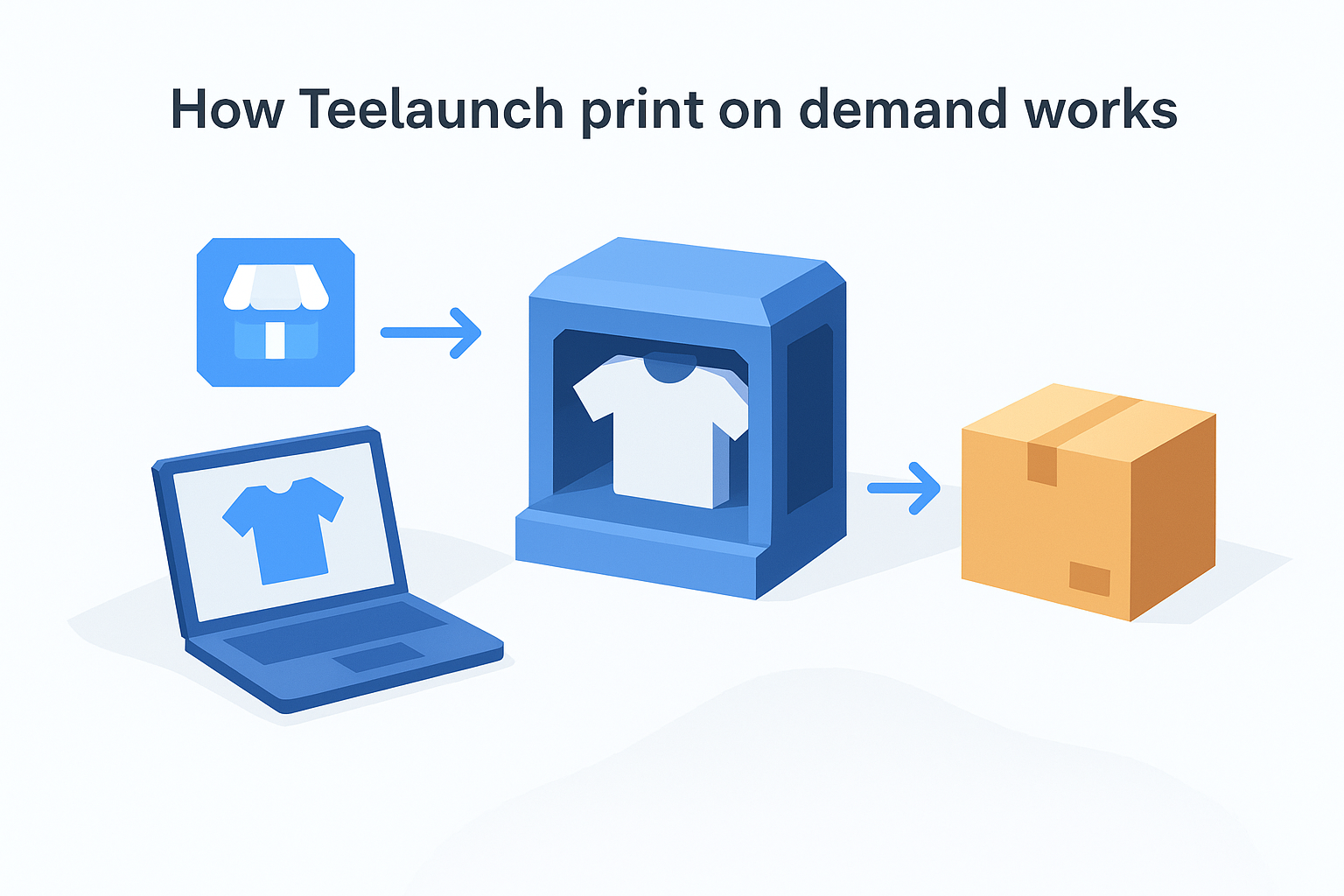
Your store stays focused on selling while Teelaunch handles production and logistics in the background.
How the order flow works
The setup starts with connecting your store through Teelaunch's native Shopify app or via the Etsy integration. You upload your design, map it to a product, and publish your listing. When an order comes in, teelaunch print on demand kicks in automatically, pulling the order data, printing to your specification, and dispatching the package under your brand name.
Production typically takes two to five business days before the order ships. You don't control the manufacturing timeline directly, which means your listing's estimated delivery window needs to account for both production and transit time. Underestimating that window is one of the faster ways to collect negative reviews, so build realistic lead times into every listing from day one rather than adjusting after the complaints arrive.
What Teelaunch sells and how customization works
Teelaunch's catalog covers a wider range of products than most sellers expect when they first look at the platform. Beyond phone cases, you'll find apparel, home goods, drinkware, and accessories. That breadth is useful if you plan to expand beyond phone cases, but it also means the platform wasn't built exclusively around any single product category.
The product catalog
Phone cases in the teelaunch print on demand catalog span a selection of iPhone and Android models, available in snap and tough case formats. The catalog updates as new devices release, though not always immediately.
The gap between a new device launch and mockup availability can cost you early sales if you're not prepared.
How customization works
You upload your design file directly through the Teelaunch dashboard, where it maps onto a product template. The platform uses a print area overlay to show you where your artwork falls on the case before you publish. This preview is functional but not production-matched, meaning it shows placement rather than confirming how the finished case will look in terms of finish, edge accuracy, or camera cutout alignment. That distinction is worth understanding before you treat the preview as a reliable representation of what your customer receives.
Teelaunch pricing and costs to plan for
Teelaunch operates on a base cost model where you pay per item produced, with no monthly subscription required to access the platform itself. That lowers the barrier to entry, but per-unit pricing on phone cases typically lands in the $8-$14 range depending on the model and case format, which means your retail price needs enough room to cover production, shipping, and platform fees before you see real margin.
Your profit isn't what's left after the base cost - it's what's left after every fee in the chain.
Shipping and additional costs to track
Shipping costs run separately from the base product price and vary by destination. For domestic US orders, budget an additional $3-$6 per shipment. With teelaunch print on demand, you also need to factor in Etsy or Shopify transaction fees on top of production and shipping, and those fees compound quickly at volume.
Running an honest margin calculation before you set your retail price is not optional. Sellers who skip this step often discover they're profitable on paper but underwater once every cost layer gets applied. Build your pricing from the full cost stack, not just the base product line item.
Pros, cons, and who Teelaunch fits best
Teelaunch print on demand has genuine strengths and real limitations. Knowing both before you build a catalog around the platform saves you from expensive rebuilds later.
What works in Teelaunch's favor
The no-subscription model keeps your overhead low when you're testing a new product category or scaling cautiously. Shopify integration is tight and reliable, which reduces the friction of setting up automated order flows if you're already running on that platform.
Teelaunch also covers a broader product range than most phone case specialists, so if you plan to expand into apparel or home goods, you can manage multiple categories through one fulfillment connection.
Where Teelaunch falls short and who it fits best
The product preview tool inside the dashboard shows placement, not production accuracy, which creates real listing risk if you treat it as a reliable representation of what ships. Catalog depth for phone cases is narrower than some competitors, and new device releases can lag market demand by several weeks.
If you're selling cases for newly released devices, timing gaps in a provider's catalog directly cost you early sales volume.
Shopify-first sellers building broad multi-category stores get the most from Teelaunch. If your business is phone case focused and listing accuracy is a priority, you'll need production-matched mockups alongside Teelaunch's tools to protect your review score.
What to do next
Teelaunch print on demand gives you a functional, low-overhead path to getting products in front of customers, especially if you're already running a Shopify store and want to test new categories without a heavy upfront commitment. The no-subscription model and tight platform integration are real advantages, and they're worth using.
But every fulfillment setup has a weak point, and for phone case sellers, listing accuracy is where the risk lives. Teelaunch prints the case. Your mockup is what sets the customer's expectation. If those two things don't match, you're absorbing the cost in returns and review damage regardless of how smoothly the fulfillment side runs.
Protecting that gap is where production-accurate phone case mockups do the work. Your listings become a promise you can keep, and your reviews become an asset you can build on rather than a metric you're quietly managing around.


