

Print on demand (POD) is a fulfillment model where products are manufactured only after a customer places an order. No bulk purchasing, no warehouse full of unsold inventory, no upfront production costs. A seller creates a design, lists it on a storefront, and a third-party manufacturer prints and ships the product directly to the buyer. That's the entire supply chain.
The model has made it possible for independent sellers to build real product businesses, phone cases, apparel, books, home goods, without the financial risk that used to come with manufacturing. But "low barrier to entry" doesn't mean "easy to do well." The sellers who actually succeed are the ones who understand how POD works at every stage, from choosing the right products and manufacturers to presenting listings that accurately represent what a customer will receive. That last part, the gap between what's shown online and what arrives in the mail, is exactly the problem we solve at Bettermockups, where our mockup templates are built from real manufactured cases so your listing matches the product.
This guide breaks down the full POD model: what it is, how the fulfillment process works, what it costs, and how to start selling. Whether you're evaluating print on demand as a business for the first time or looking to sharpen how you operate an existing shop, everything here is built to get you from concept to confident execution.
What print on demand is and what it is not
When people ask what is print on demand, they usually expect a short answer: you sell products without holding inventory. That's accurate, but it's incomplete. Print on demand is a manufacturing and fulfillment agreement between you and a third-party supplier who produces a physical product only when a real customer pays for it. The design is yours, the store is yours, and the production, packing, and shipping belong to the supplier. Every transaction triggers a new unit, and that unit gets made, labeled, and mailed without you ever touching it.
No sale means no product, and no product means no production cost. That mechanic is the foundation of the entire model.
Your role as a seller covers the creative and commercial side: design creation, storefront management, pricing, and customer communication. The supplier handles everything physical, which is the entire reason POD lets independent sellers compete in markets that would otherwise require significant upfront capital. Your margin is the difference between the supplier's base production cost and the retail price you set in your storefront.
What falls inside the POD model
Product categories in POD span two main groups: hard goods such as phone cases, drinkware, and accessories, and soft goods such as t-shirts, hoodies, and tote bags. Books represent a major POD category as well, handled by services that print and bind individual copies on demand for self-publishers and authors. The common thread across all of them is that the product doesn't exist until someone buys it, which removes the inventory risk that has historically made physical product businesses capital-intensive.
The model also applies across multiple sales channels: Etsy, Shopify, Amazon, and TikTok Shop all support POD workflows either natively or through integrations. You can run the same design across several platforms simultaneously with no additional production commitment, which is why experienced sellers often build their catalogs once and distribute them broadly.
What POD is not
POD is not traditional dropshipping. Dropshipping typically means reselling finished products from a supplier's existing catalog without any customization. Print on demand always involves your original design applied to a blank product. You are not reselling someone else's goods; you are commissioning the production of something that carries your creative work.
POD is also not a passive income setup, at least not automatically. Listings don't generate sales on their own. You need search visibility, competitive pricing, and product presentations that accurately show what a customer will receive. Sellers who treat POD as a set-and-forget operation tend to end up with stagnant shops. The ones who build real, sustained revenue treat it like any product business: with consistent attention to design quality, listing accuracy, and customer experience.
Finally, POD is not the same as custom manufacturing on demand. Custom manufacturing involves client-specified product specs, bulk minimums, and extended lead times. POD operates on standardized blank products with your graphic applied at print time. You work within the product specs your supplier already offers rather than defining the physical product from scratch. Understanding that constraint upfront helps you choose suppliers whose blanks actually match what you want to sell, which matters far more than most new sellers initially realize.
How print on demand works step by step
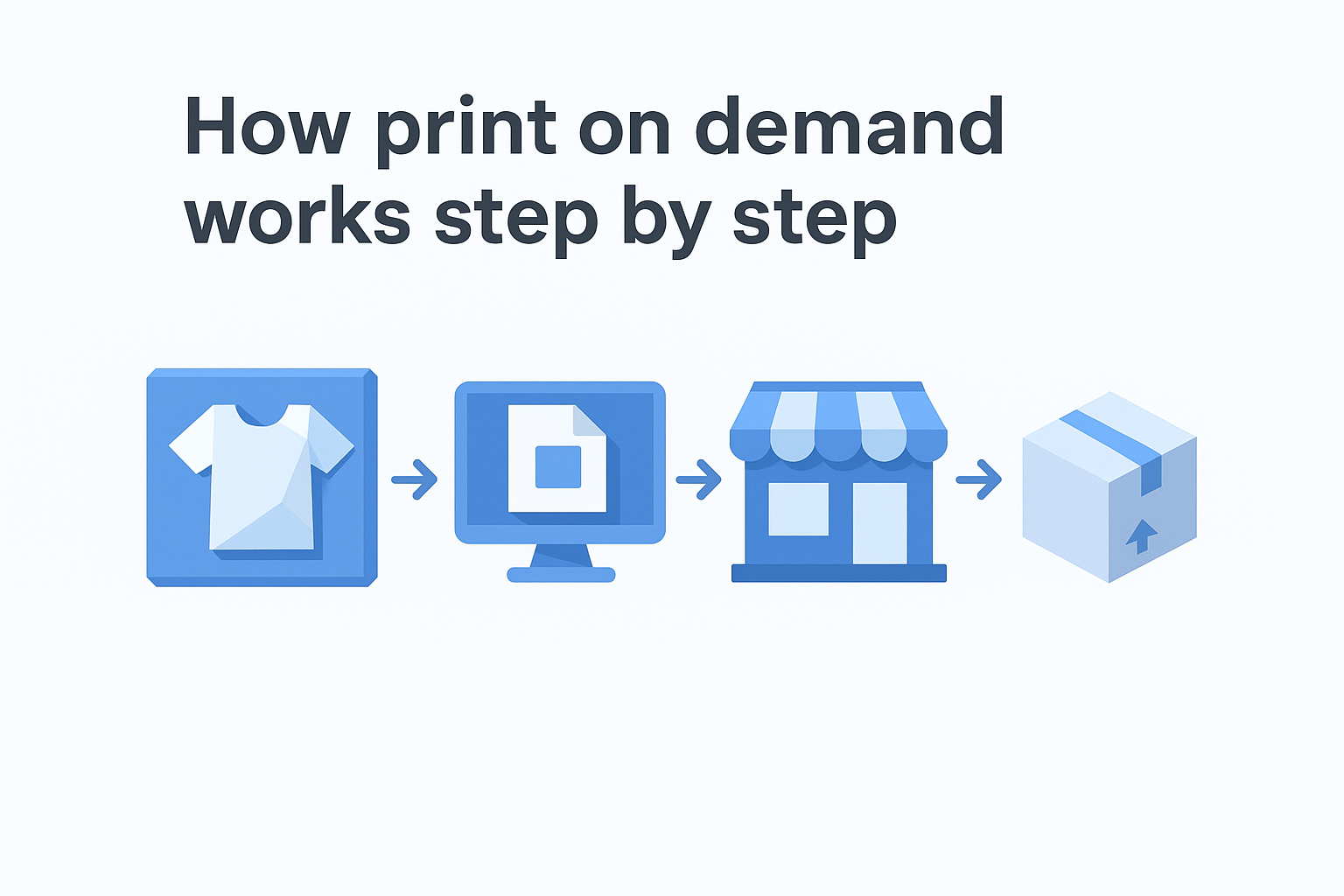
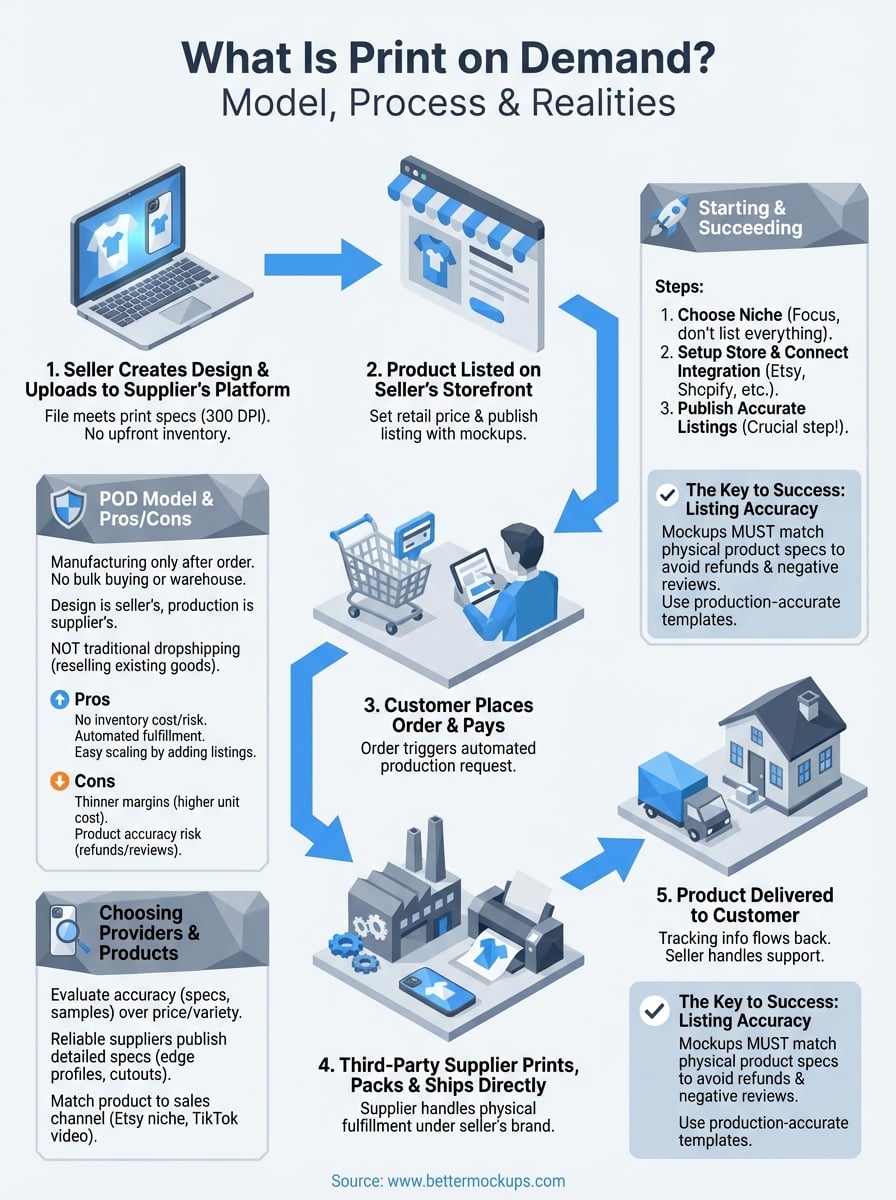
Understanding what is print on demand at a mechanical level helps you make better decisions about suppliers, products, and pricing before you list a single item. Every transaction follows the same fixed sequence: you create a design, upload it to a supplier's platform, list the product on your storefront, a customer buys, the supplier produces the item, and it ships directly to the buyer. Your responsibilities are entirely front-end and relationship-based. The physical work belongs to the supplier.
From design to listing
Your first step is creating a design file that meets your supplier's exact print specifications, which typically means 300 DPI resolution, the correct color profile, and accurate sizing for the specific product template you're working with. Each product type has its own template, and getting that file right before you publish is the difference between a listing that looks deliberate and one that ships with misaligned graphics or clipped edges.
Once the file is ready, you upload it to your supplier's platform and configure the product options available for that blank, such as device model, color, or finish. From there, you push the listing live on your storefront with a retail price, a product description, and mockup images that show the customer what the finished product will look like when it arrives.
From order to delivery
When a customer completes a purchase, the integration between your storefront and the supplier triggers an automated production request. You don't forward orders manually or monitor a queue. The supplier receives the order, prints your design onto the blank product, packages it, and ships it directly to your customer, typically under your brand name or a neutral label depending on your fulfillment setup.
Your margin is the difference between the retail price you set and the supplier's base production and shipping cost, and it's yours the moment the customer pays.
Tracking information flows back through the integration to your storefront once the order ships, and most platforms pass that directly to the customer. Your role at this stage is handling questions and resolving problems with delivered orders. The supplier fulfills the product, but you own the customer relationship, which means your listing accuracy determines how often that relationship ends with a positive review rather than a refund request.
Pros, cons, and real costs of POD
Once you understand what is print on demand mechanically, the next question is whether it fits your situation. The model has genuine structural advantages over traditional product businesses, but it also carries real limitations and costs that sellers underestimate until they've absorbed a few bad months. Knowing both sides before you commit saves you from building a business on assumptions that don't hold up.
What POD gets right
The core advantage is financial: you never pay for a product that doesn't sell. There are no minimum order quantities, no warehouse costs, and no capital tied up in unsold inventory. That changes the risk profile of launching new designs entirely. You can test ten different product concepts in a week, pull the ones that don't perform, and keep the ones that do, all without taking a production loss on the experiments.
Scaling a POD business doesn't require more upfront capital the way traditional manufacturing does. You add listings, not inventory.
Fulfillment automation is the second major advantage. Once your storefront integrations are configured, orders process and ship without manual intervention. That frees your time for design, marketing, and listing optimization, which is where your actual competitive edge lives.
Where POD falls short
Margins are thinner than most sellers expect. Your base production cost per unit is higher than it would be if you ordered in bulk, because you're paying for the convenience of single-unit manufacturing. On a phone case retailing at $18, the supplier cost plus shipping can consume $10 to $14 of that, depending on the provider and destination. Profit per order is real but modest, which means volume matters more than the upfront math suggests.
Product accuracy is the other limitation that catches sellers off guard. When your mockup doesn't match the physical product that ships, you absorb that gap as refund requests and negative reviews. Generic mockup tools are designed for t-shirts, not phone cases. The difference between a realistic render and an accurate one doesn't show up in your design file; it shows up in your review history and your platform standing.
How to start a POD business in 2026
Starting a POD business in 2026 doesn't require a sprawling business plan, but it does require making a few foundational decisions in the right order. Most sellers who struggle early make the mistake of choosing a platform before they know what they're selling, or picking a supplier before they understand what is print on demand at an operational level. The sequence matters, and the steps below reflect the order that gives you the clearest path from setup to first sale.
Choose a niche and a specific product type
Before you open an account anywhere, you need to know what you're selling and to whom. Broad product catalogs rarely help new shops because search visibility on platforms like Etsy is built around relevance, and relevance requires focus. Pick one product category, phone cases, apparel, or home goods, and identify a design style or theme that addresses a specific buyer rather than everyone.
The sellers who build durable shops pick a lane and execute it well, rather than listing everything they can think of and waiting to see what sticks.
Narrowing your focus also makes supplier selection more straightforward, since you evaluate providers against specific product requirements rather than a vague wish list.
Set up your storefront and supplier integration
Once you know your product, create your storefront on whichever platform your target audience already shops: Etsy for handmade-adjacent buyers, Shopify for brand-first sellers, or Amazon for volume-driven reach. Connect your chosen supplier through a native integration or app, which automates the order-to-fulfillment handoff and removes manual processing from your workflow entirely.
Your store setup should include accurate shop policies, clear shipping estimates, and branding that matches your product niche. Buyers form impressions fast, and a storefront that looks assembled in ten minutes sends the wrong signal before they even reach your listings.
Publish listings that accurately represent your product
Your listing is the only thing standing between a browser and a buyer. Use mockups that match your actual supplier's product specifications, including the correct edge profile, finish, and camera cutout placement for each specific product you sell.
Listings built on inaccurate visuals generate refund requests, and refund requests damage your platform standing faster than almost anything else in the POD model. Getting the visual right before you publish is not a detail, it is the work.
How to choose a POD provider and products
Choosing the right supplier is the decision that determines whether your POD business runs smoothly or generates a steady stream of refund requests. Most sellers evaluate providers based on product variety and price, but the criteria that actually matter are accuracy, integration reliability, and how well the supplier's specific blanks match what you're promising buyers. Once you understand what is print on demand at an operational level, supplier selection becomes less about finding the cheapest option and more about finding the most consistent one.
Evaluate supplier accuracy before product range
The first question to ask about any POD supplier is whether their product specs are publicly available and consistent across production runs. Suppliers like Podbase and Casestry publish detailed specifications for their phone cases, including edge profiles, finish options, and camera cutout dimensions, which makes it possible to verify that your listings reflect the actual product. Suppliers who don't publish specs or whose output varies batch to batch create accuracy problems you can't solve from the design side alone.
Your mockup is a promise to the customer, and if your supplier's product doesn't match that promise, the cost lands on your review score, not on the supplier.
Scrutinize the camera cutout placement, finish type, and case thickness for every product you plan to sell before you publish a single listing. Requesting physical samples is the most reliable way to confirm this, and it removes any ambiguity between what the spec sheet says and what the customer actually receives.
Match your product selection to your sales channel
Different sales channels reward different product types. Etsy buyers search with high purchase intent and respond well to niche designs on specific products, while TikTok Shop buyers convert more often when listings include video mockups that show the product in motion. Understanding the platform before you decide which products to list shapes your entire catalog strategy.
Narrow your initial product selection to two or three SKUs from a single supplier rather than building a wide catalog across multiple providers at once. That constraint lets you develop accurate listings, test demand, and refine your process before you expand, which produces better long-term results than launching broadly with inconsistent quality.
Where to go from here
Now you know what is print on demand at every level that matters: the model, the mechanics, the real costs, and the decisions that separate shops that grow from ones that stall. The path forward is straightforward. Pick a niche, connect a supplier whose product specs you've actually verified, and publish listings that show buyers exactly what they'll receive.
The gap between a realistic mockup and an accurate one is where most POD sellers quietly lose money through refunds, negative reviews, and damaged platform standing. That gap is fixable. If you sell phone cases through Podbase or Casestry, your listings deserve mockups built from the real manufactured product, not a generic render that looks close enough. Accurate visuals turn every listing into a promise you can keep, and every delivered order into a review that works for you. Start there: browse production-accurate phone case mockup templates.


