

Prodigi is one of those fulfillment platforms that keeps showing up in POD seller forums but rarely gets the deep breakdown it deserves. If you've been researching prodigi print on demand as a potential fulfillment partner, you've probably noticed the information out there is either surface-level or buried in outdated Reddit threads. That's a problem when you're trying to make a real decision about where to route your orders.
Prodigi offers a global manufacturing network, a wide product catalog, and an API-first approach that appeals to sellers who want more control over their fulfillment pipeline. But how it actually performs, on pricing, product quality, integrations, and turnaround, matters more than any feature list. Choosing the wrong fulfillment partner doesn't just cost you margins. It costs you reviews, repeat customers, and platform trust that took months to build.
This article breaks down Prodigi's pricing structure, product range, integration options, and how it stacks up against competitors like Printful, so you can decide whether it fits your operation or whether you should keep looking. At Bettermockups, we build production-accurate mockup templates for POD sellers using specific manufacturers, because we've seen firsthand how the gap between a listing image and a delivered product creates real business damage. Whatever fulfillment provider you choose, the mockups representing those products need to match what actually ships, and that starts with understanding exactly what your manufacturer produces.
Why sellers use Prodigi for print on demand
Prodigi's appeal isn't a single feature. It's the combination of a global manufacturing network, a white-label fulfillment model, and a catalog deep enough to support multi-product stores. When you're running a high-volume shop and your existing supplier is creating bottlenecks or restricting where you can sell, those factors together start to outweigh the per-unit savings you might get from a cheaper but less capable competitor. Understanding why sellers make the switch helps you evaluate whether those same factors apply to your operation.
A Printing Network Built for International Sales
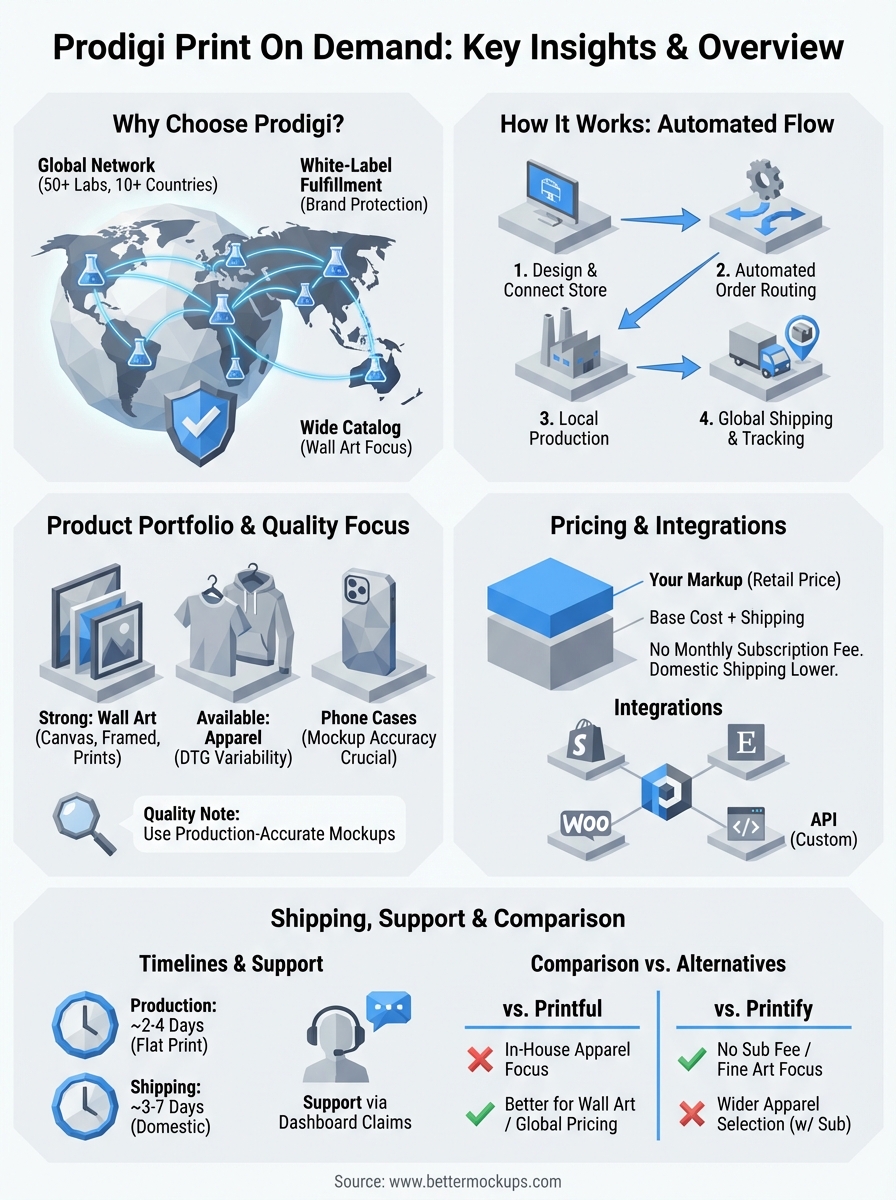
One of the most practical reasons sellers turn to prodigi print on demand is geographic coverage. Prodigi works with over 50 print labs across more than 10 countries, including the US, UK, Europe, Australia, and Canada. When a customer in Germany orders from your Shopify store, the order routes to the nearest compatible lab instead of a facility on the other side of the world. Shorter distances translate directly into faster delivery times and lower international shipping costs, which matters when you're competing with domestic sellers in those markets.
The routing logic also reduces customs friction that kills international conversions. A customer in the UK buying a product printed locally pays domestic shipping rates and avoids import fees. You get a cleaner customer experience without adjusting anything on your end. That structural advantage compounds across thousands of orders over the course of a year.
When you remove international shipping friction at the fulfillment layer, you're effectively eliminating a conversion barrier that most sellers don't even know they're carrying.
White-Label Shipping and Brand Control
Prodigi ships all orders without its own branding on the packaging. Your store name is what the customer sees, which matters more than sellers often realize until they've dealt with the opposite. Receiving a package from a third-party fulfillment company when you ordered from a branded Etsy shop breaks the brand experience you spent months building. Prodigi's white-label default protects that relationship by default rather than as an upsell.
You can also add custom packing slips to orders, which gives you a direct touchpoint for repeat purchase messaging, discount codes, or a simple note that makes the unboxing feel personal. These details separate shops that feel like real brands from shops that feel like resellers moving generic product.
Product Range That Supports Multi-Niche Stores
Prodigi's catalog runs well past the t-shirts and mugs that most POD platforms use to lead their marketing. Wall art, canvas prints, photo books, phone cases, apparel, stationery, and homeware are all available, and the range keeps expanding. If you're building a store around a specific niche or testing new product categories, working within a single supplier's catalog simplifies your operation considerably.
Multi-product sellers benefit most from this depth. Consolidating orders under one fulfillment partner simplifies accounting, reduces the number of shipping policies you have to manage, and cuts down the points of failure in your fulfillment pipeline. Every additional supplier you add introduces another integration to maintain, another support queue to navigate, and another set of production timelines to track. Reducing that complexity is a legitimate operational advantage, not just a convenience. Sellers who've managed three separate fulfillment providers simultaneously know exactly what that friction costs in time and customer service load.
How Prodigi works from design to delivery
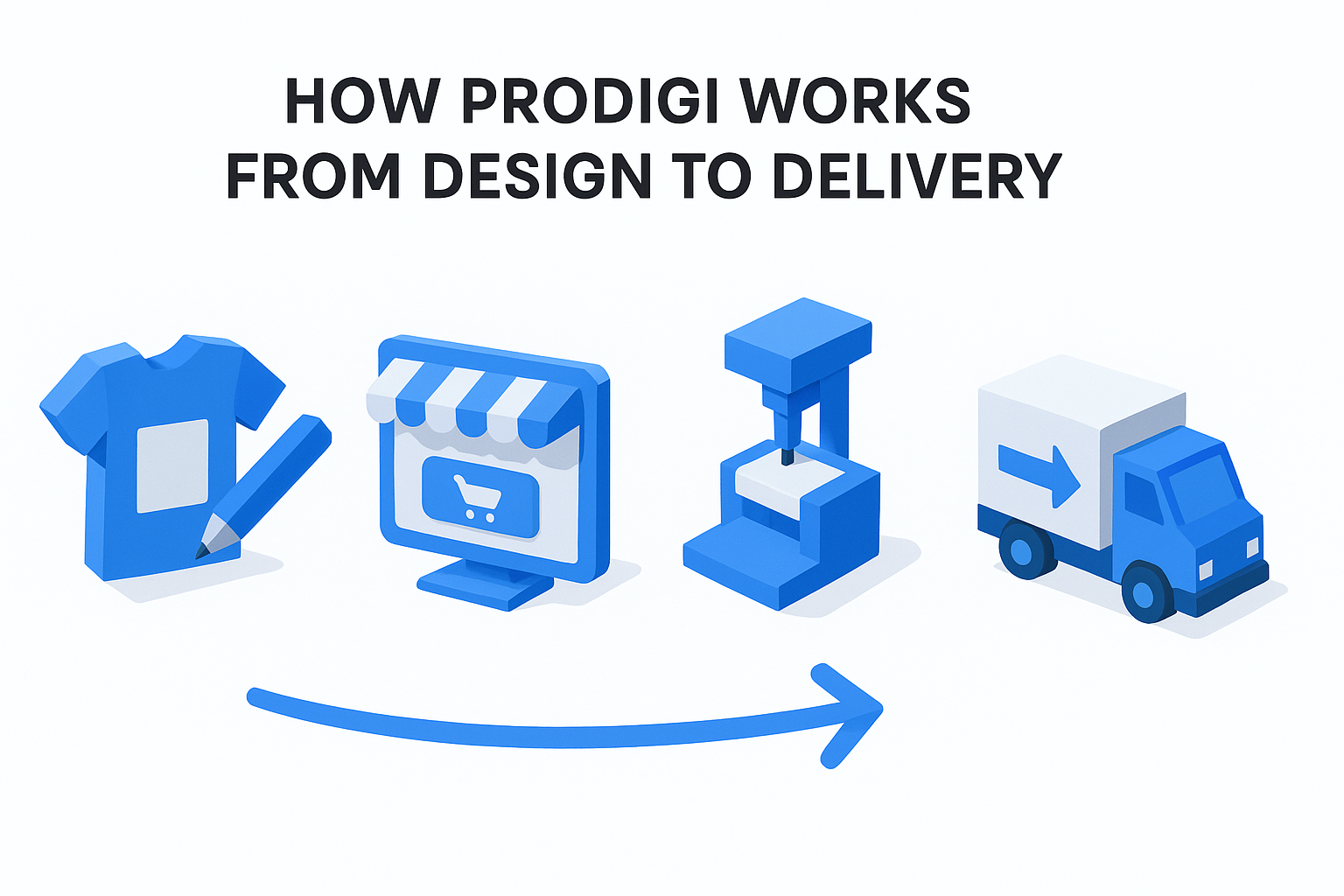
Prodigi print on demand operates on a straightforward fulfillment model: you create products, connect your store, and Prodigi handles everything from printing to shipping once a customer places an order. The process moves in predictable stages, and understanding each one helps you avoid the setup mistakes that create customer service problems later.
Setting Up Products and Uploading Artwork
You start by creating an account on Prodigi's platform and selecting the products you want to sell. Once you pick a product, you upload your design file directly into Prodigi's product editor, which shows you a preview of how the design maps to the product template. File requirements vary by product, but Prodigi generally asks for high-resolution files (300 DPI is standard for print) in formats like PNG, JPG, or PDF.
After uploading, you set your retail price, and Prodigi displays the base cost so you can calculate your margin upfront. This step matters because pricing decisions made at the product setup stage are hard to revisit cleanly once you have active listings with reviews and traffic attached to them.
Build your margin calculation before you publish, not after your first sale shows up at a price that doesn't work.
How Orders Move Through the System
When a customer places an order in your connected store, it transfers to Prodigi automatically. Prodigi's routing system selects the nearest compatible print lab from its global network and sends the job to production without requiring any manual input from you. That automation is what makes high-volume selling workable: you're not logging into a dashboard to approve individual orders.
Each order generates a confirmation, and you receive tracking information once the order ships. Prodigi passes that tracking data back to your store platform, so your customer gets the same update you do. The system handles the logistics layer end-to-end.
What Happens After It Ships
Once the order leaves the print lab, delivery time depends on the shipping method selected and the distance between the lab and the customer. Production time and shipping time are separate, which is worth communicating clearly in your store's shipping policy so customers know what to expect. Prodigi provides estimated timelines per product and per region, but real-world delivery can vary during peak periods.
If a product arrives damaged or defective, Prodigi's support process involves raising a claim through your account dashboard with photos of the issue. Approved claims result in a reprint or refund, depending on the situation.
Products and print quality to expect
Prodigi's catalog is broader than most sellers expect when they first start researching prodigi print on demand. The platform covers wall art, canvas prints, framed prints, photo books, apparel, phone cases, and home goods, which means you can build a multi-product store without routing orders through separate suppliers. Knowing what's available and what quality benchmarks to expect lets you select products that can actually deliver on what your listings promise.
Wall Art and Print Products
Wall art is where Prodigi's catalog is deepest. Fine art prints, canvas prints, framed prints, and photo tiles are all available across a range of sizes and substrates. The print quality on these products is consistently strong because the underlying technology, giclée printing on archival-quality materials, is well-established and the tolerances are predictable. Colors reproduce accurately when you submit properly profiled files, and the finished product holds up to the kind of close inspection a customer does when they hang something on their wall.
Submit files in sRGB color space when printing through Prodigi unless the product spec sheet specifically calls for CMYK, because screen-to-print color accuracy depends on matching the profile your lab is using.
Photo books and stationery products follow similar quality standards. The binding and paper stock on photo books are solid enough for personal gifting use cases, though they're not positioned as premium luxury items.
Apparel
Prodigi carries t-shirts, hoodies, tote bags, and a selection of other soft goods fulfilled through partner labs rather than a single internal facility. Print quality on apparel varies more than on flat print products because direct-to-garment results depend heavily on fabric composition, pretreatment, and the specific lab handling the order. Light designs on dark garments carry more risk of inconsistency than dark designs on light fabric, which is a standard limitation across all DTG fulfillment, not specific to Prodigi.
Phone Cases and Specialty Products
Phone cases are available through Prodigi, but this is where accuracy becomes a sharper concern than in other product categories. Generic mockup previews that don't reflect the actual case geometry, camera cutout placement, or finish type create a gap between what you show and what ships. If you're selling phone cases specifically, the product specs of whatever manufacturer Prodigi routes your order to need to be matched by the mockups you use in your listings. A listing image that misrepresents the camera cutout or edge profile isn't just inaccurate, it's a refund waiting to happen.
Pricing and fees, explained with examples
Prodigi print on demand uses a base cost plus markup model, which is the same structure most POD platforms use. You pay Prodigi the base manufacturing and shipping cost for each order, and you keep the difference between that cost and whatever retail price you set. There are no monthly subscription fees to access the core platform, which makes it easy to start without a fixed overhead commitment. That said, the actual numbers matter more than the model, so understanding what you're paying per product and per shipment is where most sellers need to spend more time before committing.
How Prodigi's Base Pricing Works
Prodigi lists base prices per product in their catalog, and those prices vary depending on the product type, size, and which print lab fulfills the order. A standard canvas print in a smaller size will carry a lower base cost than a large framed print, which is expected, but the spread between product categories is wider than sellers sometimes anticipate. Wall art tends to be more competitively priced than apparel through Prodigi, partly because the platform's strength sits in flat print products rather than soft goods.
Check the base price for each specific size and variant you plan to sell before you build your pricing structure, because cost differences across sizes compound across hundreds of orders.
Currency and regional pricing can shift slightly depending on which lab fulfills the order, so sellers operating in multiple markets should account for that variability when setting margins.
A Realistic Example of Margin Calculation
Suppose you're selling a mid-size canvas print. Prodigi's base cost for that product might land around $18 to $22 depending on the lab and size, with shipping adding another $5 to $9 for a domestic US delivery. Your total landed cost per order sits somewhere between $23 and $31 before you factor in any platform fees from Etsy or Shopify. If you price the listing at $49.99, your margin after fulfillment is roughly $19 to $27 before platform commissions.
Platform transaction fees typically run 5 to 15 percent of the sale price depending on which channel you're selling on, so your real take-home on a $49.99 sale could be closer to $12 to $20. Running these numbers per product before you publish is not optional if you want a store that actually sustains itself rather than one that looks profitable on paper until you review the actual deposits.
What You Pay for Shipping
Prodigi charges shipping separately from the product base cost, and the rate depends on the destination country and the print lab routing the order. Domestic shipping within the US, UK, or EU tends to run lower because local labs fulfill local orders, which is one of the practical financial benefits of Prodigi's distributed network. International orders fulfilled from a distant lab carry higher shipping costs, and that expense either compresses your margin or pushes your retail price higher than local competitors.
Integrations with Shopify, Etsy, and more
Prodigi print on demand connects to the platforms most POD sellers are already using, which means you don't need to rebuild your workflow to add it as a fulfillment partner. The integration setup is straightforward, but the depth of what each connection actually does varies by platform, and knowing those differences before you connect prevents the kind of fulfillment gaps that generate customer complaints.
Shopify and Etsy
Prodigi offers a direct Shopify app that you install from the Shopify App Store. Once installed, you can browse Prodigi's catalog, create products, and sync them to your storefront without jumping between tabs. Orders that come in through Shopify route to Prodigi automatically, so there's no manual step between a customer buying and production starting. Tracking information flows back into Shopify and updates your order status the same way a native fulfillment service would.
The Shopify integration works cleanest when you set up your Prodigi products directly through the app rather than importing them later, because the product data links are established at creation and don't need to be remapped.
The Etsy integration works through Prodigi's order sync, which pulls new Etsy orders into your Prodigi dashboard and routes them to the appropriate lab. Setup requires connecting your Etsy account through Prodigi's platform settings, and once linked, new orders appear automatically. One thing to watch: Etsy's listing management stays on Etsy's side, so you create and update your listings natively on Etsy rather than through Prodigi's product editor.
WooCommerce and Other Platforms
Prodigi supports WooCommerce through a plugin that mirrors the functionality of the Shopify app. If you're running a WordPress-based store, the plugin handles order forwarding and tracking updates without requiring custom code. The setup process is similar, connect your store credentials, browse products, and publish directly to your storefront.
Squarespace and Wix sellers have fewer native options, which often pushes them toward using Prodigi's API for direct integration rather than a point-and-click plugin.
API Access for Custom Storefronts
Prodigi publishes a REST API that lets developers build direct fulfillment connections into any storefront or internal system. This is the integration path for sellers running custom-built stores or anyone who wants more control over how orders are submitted and tracked than a standard plugin provides. You authenticate with an API key, submit orders programmatically, and receive webhooks for status updates and tracking data. The API documentation is detailed enough that a developer familiar with REST integrations can build a working connection without significant back-and-forth.
Shipping, production times, and support
When you're running a high-volume store, shipping speed and production reliability determine whether your customer experience holds together or unravels one late order at a time. With prodigi print on demand, both timelines operate independently, which means your listed delivery estimate needs to account for both production and transit rather than treating them as a single number.
Production Timelines by Product Type
Production time varies by product category, and Prodigi publishes estimates per product in their catalog. Standard flat print products like canvas prints or posters typically produce in two to four business days, while apparel and specialty products can take slightly longer depending on the lab handling the job. These estimates reflect normal operating conditions, and peak periods around holidays or major sales events can extend them.
Build your store's stated delivery window around the longer end of Prodigi's production estimates, not the shorter end, so you're under-promising rather than over-delivering surprises.
Custom framed products and photo books carry longer production windows than standard prints because the finishing steps require more manual handling. If you're listing these product types, your shipping policy language needs to reflect that difference specifically rather than applying a blanket timeline across your whole catalog.
Shipping Speed and Regional Coverage
Prodigi routes orders to the nearest compatible lab in its global network, which directly affects how fast the finished product reaches your customer. Domestic orders within the US, UK, or EU typically arrive within three to seven business days after production completes, depending on the shipping method selected at checkout. International orders routed through labs in the destination region follow similar timelines, while cross-regional shipments take longer.
Standard and express shipping options are available at different price points, and the method available for a specific order depends on both the product type and the fulfilling lab's carrier options. You can't always guarantee express delivery across every product in your catalog, so check which options apply to your core products before making promises in your store's shipping policy.
Getting Support When Orders Go Wrong
Prodigi's support process runs through your account dashboard rather than a public phone line. When a defective or damaged order arrives, you open a claim directly inside the Prodigi platform, attach photos of the issue, and Prodigi reviews the claim to determine whether a reprint or refund applies. Most straightforward defect claims resolve without extended back-and-forth.
Response times through their support channel are typically within one business day for standard inquiries, though complex cases involving multiple affected orders can take longer to resolve. Keeping clear photo documentation of every defective item you receive speeds up the process considerably.
Phone cases: specs, mockups, and accuracy
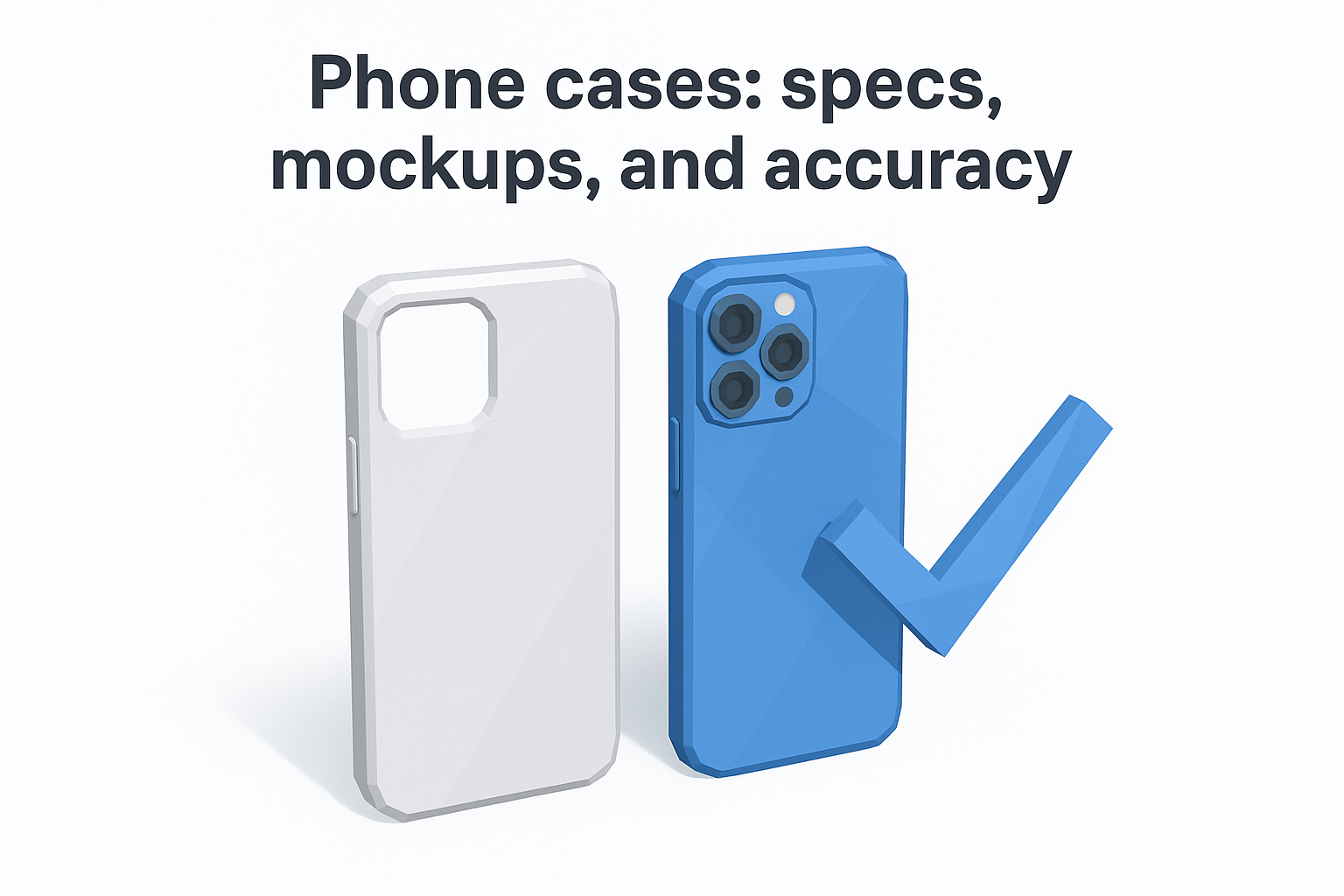
Phone cases are available through prodigi print on demand, but they come with a layer of complexity that flat print products don't carry. The physical geometry of a case, including edge profile, camera cutout placement, button recesses, and finish type, varies by manufacturer and by device model. Getting these details wrong in your listing images creates a gap between what your customer expects and what they receive, and that gap shows up as refund requests and negative reviews rather than a line item on a spreadsheet.
How Prodigi Routes Phone Case Orders
Prodigi fulfills phone cases through partner labs, and the specific manufacturer handling your order depends on which lab the routing system selects. That manufacturer's physical case specs determine what your customer actually receives: the exact edge radius, the finish, the camera cutout size, and the MagSafe ring placement on compatible models. You don't always get to specify which lab handles a phone case order the way you might prefer to lock a supplier for a custom product, so understanding the range of specs your orders might land on matters before you build out your catalog.
If you're running a high-volume phone case store, verify which manufacturers your fulfillment partner routes to and pull the physical specs before you finalize any listing images.
Why Mockup Accuracy Is a Separate Problem
Most mockup platforms generate phone case templates that look realistic without being accurate. A template that shows a slightly wrong camera cutout or a glossy finish when the case ships matte isn't just an aesthetic problem. It's a product representation problem that your customer notices the moment the package arrives. Sellers who absorb these discrepancies as "just how POD works" are actually absorbing refund costs and review damage that come directly from a fixable asset problem.
Generic mockup generators built for t-shirts don't account for device-specific case geometry. The camera bump on an iPhone 16 Pro sits differently than on an iPhone 15, and the edge profile on a snap case differs from a tough case even when both cases carry the same design. Using a template that doesn't reflect those differences means every listing is making a promise you can't keep.
Matching Your Mockups to What Ships
The fix is using mockup templates that are built against actual manufactured cases from the specific supplier fulfilling your orders. Production-accurate mockups eliminate the gap between your listing image and your delivered product, which means your five-star reviews come from customers who got exactly what they expected rather than customers who gave you the benefit of the doubt.
Comparing Prodigi to top alternatives
No single fulfillment platform wins across every category, and prodigi print on demand is no exception. Where Prodigi stands out is in its global routing network and its depth in flat print products like wall art and canvas. Where it trails competitors is in apparel breadth and the kind of seller-facing tooling that newer platforms have prioritized. Understanding the practical differences between Prodigi and its main competitors helps you pick the right partner for your specific product mix rather than defaulting to whichever platform has the loudest marketing.
Prodigi vs. Printful
Printful is the most direct comparison because both platforms target serious POD sellers rather than casual hobbyists. Printful runs its own in-house production facilities in North America and Europe, which gives it tighter quality control over apparel specifically. If soft goods are your primary product category, Printful's vertical integration tends to produce more consistent direct-to-garment results than Prodigi's partner-lab model.
Where Prodigi pulls ahead is on wall art, canvas prints, and framed products, where its global routing network and per-unit pricing give it a cost and coverage advantage over Printful's more centralized operation.
Prodigi's pricing on flat print products runs lower than Printful's in many categories, which matters when you're calculating margins across a high-volume store. Printful also charges for storage and fulfillment of custom inventory if you use their warehousing service, while Prodigi's model stays purely print-on-demand without those add-on costs layered on top.
Prodigi vs. Printify
Printify operates similarly to Prodigi in that both platforms work through networks of third-party print providers rather than running their own production. Printify's network is larger in terms of raw supplier count, which gives you more options for certain product categories but also introduces more variability in quality across orders because you're working across a wider range of unrelated labs.
Printify offers a premium subscription tier that reduces base product costs across the catalog, which makes financial sense if your order volume justifies the monthly fee. Prodigi doesn't charge a subscription for core access, so if you're operating at lower volumes or testing a new product category, the no-subscription model keeps your fixed costs lower while you validate demand. Printify's apparel selection is wider, but Prodigi's strength in fine art print products combined with its distributed global fulfillment network makes it the stronger choice for sellers whose catalog leans toward wall art, canvas prints, and photo products rather than clothing.
Next steps
Prodigi print on demand works well for sellers who need global fulfillment coverage and a deep catalog of flat print products without paying a monthly subscription to access it. If your store leans toward wall art, canvas prints, or framed products, Prodigi gives you a cost-effective path to international customers that most single-facility platforms can't match. For apparel-heavy stores, competitors like Printful will serve you better. The honest move is to test Prodigi with your core product category, calculate your real margins including shipping, and measure quality on the first few orders before you migrate existing listings.
Phone cases deserve extra attention regardless of which fulfillment partner you choose. Your listing images need to match what your manufacturer actually produces, or you're building refund risk into every sale you make. If you're selling phone cases and want mockups that are built against real manufactured specs rather than generic templates, start with production-accurate phone case mockups before your next listing goes live.


