

Many entrepreneurs believe selling phone cases guarantees easy profits, but the reality varies dramatically by business model and execution. Some sellers earn modest side income while others scale to six figures annually. This guide cuts through the hype with data-backed profit ranges, market analysis, and actionable strategies. You’ll learn realistic earnings from print-on-demand operations, vending machines, and Etsy shops, plus how 2026 market dynamics affect your revenue potential. Whether you’re launching a new venture or optimizing an existing shop, understanding these profitability factors helps you make smarter business decisions and set achievable income goals.
Table of Contents
- Understanding Earnings Potential For Phone Case Sellers
- Market Size And Growth Prospects For Phone Case Businesses In 2026
- Comparing Sales Models: POD, Vending Machines, And Etsy Success Stories
- Factors Affecting Profitability And Strategies For Growth
- Explore Mockup Tools To Boost Your Phone Case Business
Key takeaways
| Point | Details |
|---|---|
| POD earnings potential | Custom print-on-demand sellers typically earn $30,000 to $100,000 annually with 30 to 50 percent net margins. |
| Market size and growth | The global phone case market reached $27 to $35 billion in 2026 and continues growing 5 to 6.5 percent annually. |
| Vending machine income | Phone case vending units generate $800 to $5,000 monthly net profit depending on location and sales volume. |
| Top seller performance | Successful Etsy POD shops have scaled from $280,000 first year revenue to over $1 million annually. |
| Marketing effectiveness | Social media marketing shows weak correlation with direct sales, so focus on organic channels and upsells instead. |
Understanding earnings potential for phone case sellers
Custom print-on-demand phone case sellers earn $30,000 to $100,000 annually with net margins between 30 and 50 percent. Monthly profits typically range from $2,500 to $8,000 depending on sales volume, pricing strategy, and operational efficiency. These figures reflect established sellers who have optimized their product offerings and marketing channels.
The print-on-demand model reduces financial risk by eliminating upfront inventory costs. You only pay for production when customers place orders, which preserves cash flow and allows rapid design iteration. This flexibility particularly benefits new sellers testing niche markets without committing to bulk inventory purchases.
Profit margins depend heavily on several variables:
- Product pricing relative to production costs and platform fees
- Order volume consistency and seasonal demand patterns
- Design uniqueness and target audience specificity
- Marketing efficiency and customer acquisition costs
Net margin ranges help set realistic expectations for entrepreneurs entering this space. A 30 percent margin means you keep $3 for every $10 in revenue after covering all costs. Higher margins around 50 percent require premium pricing, efficient operations, or both. Most sellers fall somewhere in the middle depending on their niche and business maturity.
“The difference between struggling and thriving often comes down to niche selection and consistent marketing execution rather than product quality alone.”
New sellers should expect lower profits initially while building brand awareness and refining their product mix. Established shops with loyal customers and optimized listings achieve the higher end of the earnings range. Understanding these benchmarks prevents disappointment and helps you gauge progress realistically as you grow your print-on-demand phone cases business.
Market size and growth prospects for phone case businesses in 2026
The global phone case market reached $27 to $35 billion in 2026, driven by sustained smartphone adoption and accessory demand worldwide. Industry analysts project compound annual growth rates between 5 and 6.5 percent through 2033 to 2035, potentially expanding the market to $35 to $44 billion. This steady growth creates ongoing opportunities for new sellers entering the space.
Several factors fuel this market expansion. Smartphone penetration continues rising in emerging markets, creating fresh customer bases for protective accessories. Consumers increasingly view phone cases as fashion statements rather than purely functional items, driving demand for diverse designs and premium materials. New smartphone models released annually create replacement cycles as buyers seek cases compatible with updated device dimensions.
However, 2026 presents specific challenges affecting growth projections. Memory component shortages have increased smartphone production costs, potentially slowing device upgrade cycles. When consumers delay purchasing new phones, they also postpone buying new cases. This dynamic may temporarily compress demand growth compared to historical trends.
| Market Metric | 2026 Value | Projected 2033-2035 |
|---|---|---|
| Total market size | $27-35 billion | $35-44 billion |
| Annual growth rate | 5-6.5% CAGR | Sustained moderate growth |
| Key growth driver | Smartphone adoption | Design innovation |
| Primary risk factor | Slower upgrade cycles | Price sensitivity |
Pro Tip: Bundle phone cases with complementary tech accessories like screen protectors or charging cables to increase average order values and capture more margin per transaction. Customers appreciate the convenience while you boost profitability beyond standalone case sales.
Understanding phone case market growth and profitability trends helps you time market entry and adjust inventory strategies. While short-term headwinds exist, the fundamental demand for protective and decorative smartphone accessories remains strong. Entrepreneurs who adapt to shifting consumer preferences and economic conditions can still build profitable businesses within this expanding market.
Comparing sales models: POD, vending machines, and Etsy success stories
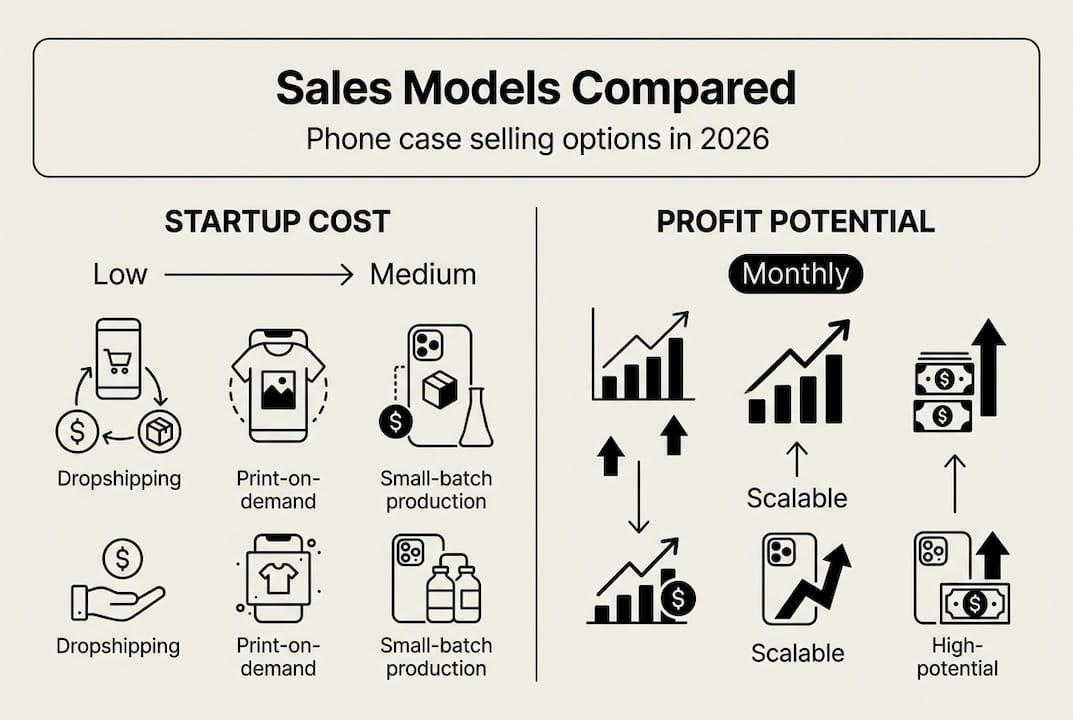
Different sales channels offer distinct profit profiles, startup requirements, and scaling potential for phone case sellers. Understanding these trade-offs helps you choose the model that aligns with your resources and business goals.
Print-on-demand platforms provide the lowest barrier to entry. You design products, list them online, and only pay production costs when orders arrive. This model supports rapid experimentation with designs and niches without inventory risk. Monthly net profits typically range from $2,500 to $8,000 for established sellers, with 30 to 50 percent margins. The main challenge involves standing out among thousands of competing sellers through superior designs and marketing.
Vending machines offer passive income potential with minimal ongoing effort. Phone case vending machines generate $800 to $2,000 monthly net per unit at moderate sales volumes, or $1,300 to $5,000 monthly with optimized high-traffic locations achieving 3 to 10 daily sales at $15 to $18 profit per transaction. Upfront costs include machine purchase, inventory, and location fees. Scalability requires managing multiple units across different locations, which adds logistical complexity.

Etsy represents a hybrid approach combining marketplace visibility with brand building opportunities. Successful POD sellers on Etsy demonstrate impressive scaling potential. One documented case shows a seller growing from $280,000 first year revenue to over $1 million annually selling phone cases and leather goods. Etsy’s organic search traffic and niche-focused buyer base provide built-in customer discovery that independent websites lack.
| Sales Model | Startup Cost | Monthly Net Profit | Scalability | Marketing Demands |
|---|---|---|---|---|
| Print-on-Demand | $100-500 | $2,500-8,000 | High (unlimited designs) | Moderate to high |
| Vending Machines | $3,000-8,000 | $800-5,000 per unit | Medium (location dependent) | Low (foot traffic) |
| Etsy POD Shop | $100-500 | $2,500-10,000+ | Very high (proven $1M+ cases) | Moderate (SEO focused) |
Research reveals that social media marketing shows surprisingly weak correlation with actual sales performance. This finding suggests entrepreneurs should prioritize organic search optimization and customer retention over expensive social campaigns with uncertain returns.
Pro Tip: Implement upsells and product bundles to capture up to 33 percent of total revenue. Offering related accessories at checkout significantly improves profitability without acquiring additional customers.
Exploring different phone case shop income potential and selling phone cases online tips helps you match business models to your strengths. Some entrepreneurs excel at design and prefer POD flexibility, while others value the passive income consistency vending machines provide. The most successful sellers often diversify across multiple channels to reduce dependence on any single platform.
Factors affecting profitability and strategies for growth
Profit margins in phone case businesses fluctuate based on controllable factors like pricing and costs, plus external variables including consumer demand shifts and market conditions. Understanding these dynamics helps you optimize operations and anticipate challenges.
Cost of goods directly impacts your bottom line. POD production costs vary by case type, customization complexity, and order volume. Premium materials command higher prices but also increase production expenses. You must balance quality expectations against margin preservation. Platform fees on marketplaces like Etsy or Amazon further compress margins, typically taking 5 to 15 percent of each sale.
Pricing strategy determines both sales volume and per-unit profit. Price too high and you lose customers to competitors. Price too low and you sacrifice margin unnecessarily. Successful sellers test different price points while monitoring conversion rates and total profit. Niche products targeting specific audiences often support premium pricing better than generic designs competing primarily on cost.
Consumer demand faces pressure from 2026 smartphone market dynamics. Higher device prices due to component shortages may slow upgrade cycles, reducing the frequency customers need new cases. This trend emphasizes the importance of design innovation and marketing to maintain sales velocity despite market headwinds.
Marketing effectiveness varies dramatically by channel. Studies show social media marketing has minimal sales correlation, with statistical analysis revealing R-squared values below 0.01. This finding challenges conventional wisdom about social media’s importance. Instead, organic search optimization, email marketing, and customer reviews drive more reliable results.
Key strategies for profitable growth include:
- Optimize product listings with keyword-rich titles and detailed descriptions for organic search visibility
- Leverage marketplace algorithms by maintaining high seller ratings and fast shipping times
- Implement email sequences to convert first-time buyers into repeat customers
- Use analytics to identify top-performing designs and double down on successful patterns
Upsells and bundles contribute approximately 33 percent of revenue for optimized shops. Offering complementary products at checkout or in follow-up emails significantly boosts average order value without proportional increases in marketing costs. This strategy improves profitability more efficiently than acquiring entirely new customers.
Follow this sequence to scale your phone case business systematically:
- Conduct market research to identify underserved niches with specific design preferences
- Create a focused product line addressing that niche rather than offering generic designs
- Choose sales channels matching your target audience’s shopping behavior and platform strengths
- Build customer retention systems including email marketing and loyalty incentives
- Analyze performance data monthly to identify growth opportunities and eliminate underperforming products
- Reinvest profits into inventory expansion or additional sales channels once core operations stabilize
“Diversifying revenue streams protects against platform algorithm changes and market shifts that can devastate single-channel businesses overnight.”
Pro Tip: Avoid overreliance on paid advertising or unpredictable social media trends. Build sustainable traffic through SEO, marketplace optimization, and word-of-mouth referrals that compound over time without ongoing ad spend.
Exploring selling phone cases online strategies and POD strategies for phone cases provides tactical guidance for implementing these growth principles. The 2026 landscape rewards sellers who adapt quickly to changing conditions while maintaining operational discipline and customer focus.
Explore mockup tools to boost your phone case business
Visual presentation directly impacts conversion rates in e-commerce. Customers cannot physically handle products online, so they rely entirely on images to assess quality and design appeal. Professional mockups bridge this gap by showcasing phone cases in realistic, attractive contexts that highlight features and build buyer confidence.
Bettermockups offers specialized tools designed specifically for phone case sellers. The new mockups collection includes fresh templates optimized for current design trends and platform requirements. These customizable assets help you create compelling product listings quickly without expensive photography equipment or technical skills.
Video content increasingly drives engagement and sales across e-commerce platforms. The phone case video mockups collection provides animated templates showing cases from multiple angles with smooth transitions. These dynamic presentations capture attention in crowded marketplaces and social feeds, giving your products a competitive edge over static images.
For sellers focusing on the dominant smartphone platform, iPhone case mockups deliver device-specific templates ensuring accurate proportions and realistic rendering. These specialized mockups help customers visualize exactly how designs appear on their specific phone models, reducing uncertainty and returns while improving conversion rates.
FAQ
How much profit can a new seller expect with print-on-demand phone cases?
New POD sellers typically earn $2,500 to $4,000 monthly profit after establishing their shop and building initial traction. Margins around 30 to 40 percent are common initially as you optimize pricing and reduce customer acquisition costs. Profits increase as you refine your niche, improve designs based on customer feedback, and build repeat buyer relationships. Exploring POD phone case profit expectations provides detailed benchmarks for different business stages.
What are the best channels to sell phone cases for maximum profit?
Etsy print-on-demand shops often scale highest revenues organically due to built-in search traffic and niche-focused buyers. Vending machines offer reliable passive income but lower scalability since each unit requires physical placement and maintenance. Diversifying across multiple channels optimizes profitability while reducing risk from algorithm changes or platform policy shifts. Review best phone case sales channels for detailed channel comparisons and selection guidance.
How might 2026 smartphone market changes affect phone case sales?
Memory component shortages have increased smartphone prices, potentially reducing device replacement frequency among cost-conscious consumers. Slower upgrade cycles could pressure phone case demand growth as customers keep existing devices longer. Entrepreneurs should monitor these 2026 smartphone market changes and consider diversifying into complementary tech accessories to maintain revenue stability.
Does social media marketing effectively drive phone case sales?
Research shows social media marketing has surprisingly weak correlation with direct sales, with statistical analysis revealing minimal predictive value. This suggests entrepreneurs should prioritize organic search optimization, marketplace visibility, and customer retention over expensive social campaigns. Focus marketing budgets on proven channels like SEO and email that demonstrate measurable returns rather than following trends with uncertain outcomes.
What profit margin should I target for a sustainable phone case business?
Target net margins between 30 and 50 percent for long-term sustainability and growth. Lower margins around 30 percent work if you achieve high sales volume, while premium niches support 50 percent margins with smaller customer bases. Calculate margins after accounting for all costs including production, platform fees, shipping, marketing, and your time investment. Regularly review pricing and costs to maintain healthy margins as market conditions evolve.


