

Many entrepreneurs believe phone case businesses generate passive income with minimal effort, but the reality involves strategic planning, cost management, and consistent marketing. Understanding true earnings potential helps you set realistic goals and avoid common pitfalls that sink new ventures. This guide reveals what phone case businesses actually earn in 2026, breaks down cost structures, and shares proven strategies to maximize profitability in a competitive market.
Table of Contents
- Understanding Phone Case Business Earnings In 2026
- Comparing Phone Case Business Models For Earnings And Profitability
- Maximizing Earnings: Marketing And Design Strategies For 2026
- Projecting Earnings And Managing Costs Effectively
- Enhance Your Phone Case Business With Professional Mockups
- What Factors Most Influence Phone Case Business Earnings?
Key takeaways
| Point | Details |
|---|---|
| Earnings vary widely | Monthly income ranges from $500 to $10,000+ depending on design quality, marketing effectiveness, and business model choice. |
| Cost management matters | Production, shipping, platform fees, and advertising typically consume 60-75% of revenue, making expense control critical. |
| Marketing drives success | Targeted social media campaigns and unique designs directly impact conversion rates and average order values. |
| Business model impacts margins | Print-on-demand offers lower risk but tighter margins compared to wholesale or custom production approaches. |
Understanding phone case business earnings in 2026
Phone case businesses generate revenue through multiple channels, each with distinct earning potential. Print-on-demand sales form the foundation for most new entrepreneurs, allowing you to sell designs without inventory investment. Wholesale partnerships with retailers provide bulk order opportunities at lower per-unit margins but higher volume. Custom orders from businesses or influencers often command premium pricing for exclusive designs.
Revenue alone tells an incomplete story. Your actual earnings depend heavily on cost structure. Production costs for print-on-demand typically range from $8 to $15 per case, depending on materials and printing quality. Shipping adds another $3 to $8 per order domestically. Platform fees consume 3-15% of each sale, with marketplaces like Etsy charging higher percentages than independent Shopify stores. Marketing expenses vary dramatically, from $200 monthly for organic social media efforts to $2,000+ for paid advertising campaigns.
Earnings vary widely based on design quality, marketing, and platform chosen, making it essential to track metrics closely. Market trends in 2026 favor personalized designs, eco-friendly materials, and video content showcasing products in real-world scenarios. Businesses adapting to these preferences see 30-40% higher conversion rates than those using generic product photos.
Average earning ranges break down by business scale. Solo entrepreneurs running part-time operations typically net $500 to $2,000 monthly after expenses. Full-time operators with established brands earn $3,000 to $8,000 monthly. Top performers with strong social media followings or multiple sales channels can exceed $10,000 monthly, though this represents less than 5% of phone case businesses.
Key revenue drivers:
- Design uniqueness and visual appeal
- Marketing channel effectiveness
- Customer retention and repeat purchase rates
- Pricing strategy aligned with target market
- Product quality and fulfillment speed
| Business Scale | Monthly Revenue | Net Earnings | Typical Margin |
|---|---|---|---|
| Part-time starter | $1,500-$4,000 | $500-$1,200 | 25-35% |
| Full-time operator | $8,000-$20,000 | $3,000-$7,000 | 35-40% |
| Established brand | $25,000-$50,000+ | $10,000-$20,000+ | 40-45% |
Pro Tip: Track your customer acquisition cost versus lifetime value from day one. If acquiring a customer costs more than their first purchase, you need repeat buyers or higher order values to reach profitability.
Comparing phone case business models for earnings and profitability
Your business model fundamentally shapes earning potential and risk exposure. Print-on-demand requires virtually no upfront investment, making it ideal for testing designs and markets. You pay only when customers order, eliminating inventory risk. However, per-unit costs remain high, limiting profit margins to 25-40% typically. Scaling proves challenging since you cannot negotiate better rates until reaching significant volume.

Wholesale operations flip this equation. You purchase cases in bulk at $3 to $6 per unit, then sell to retailers at $8 to $12, who mark up to $20-$30 for consumers. This model demands $2,000 to $10,000 initial investment for inventory and storage. Your margins improve to 50-60%, but you assume inventory risk and need reliable retail partnerships. Print-on-demand model generally offers lower upfront costs but tighter margins compared to wholesale or custom production, making model selection crucial for long-term success.
Custom production occupies middle ground. You work with manufacturers to create unique designs or materials, ordering batches of 100-500 units. Upfront costs range from $1,000 to $5,000 per design. Per-unit costs drop to $4 to $8, while you maintain premium pricing control. This approach works best when you have validated demand and established marketing channels.
Model comparison factors:
- Initial capital requirements
- Profit margin potential
- Scalability limitations
- Time investment needed
- Risk tolerance alignment
| Model | Upfront Cost | Per-Unit Cost | Typical Margin | Best For |
|---|---|---|---|---|
| Print-on-demand | $0-$500 | $12-$18 | 25-40% | Testing designs, minimal risk |
| Wholesale | $2,000-$10,000 | $3-$6 | 50-60% | Established brands, retail partners |
| Custom production | $1,000-$5,000 | $4-$8 | 45-55% | Unique products, proven demand |
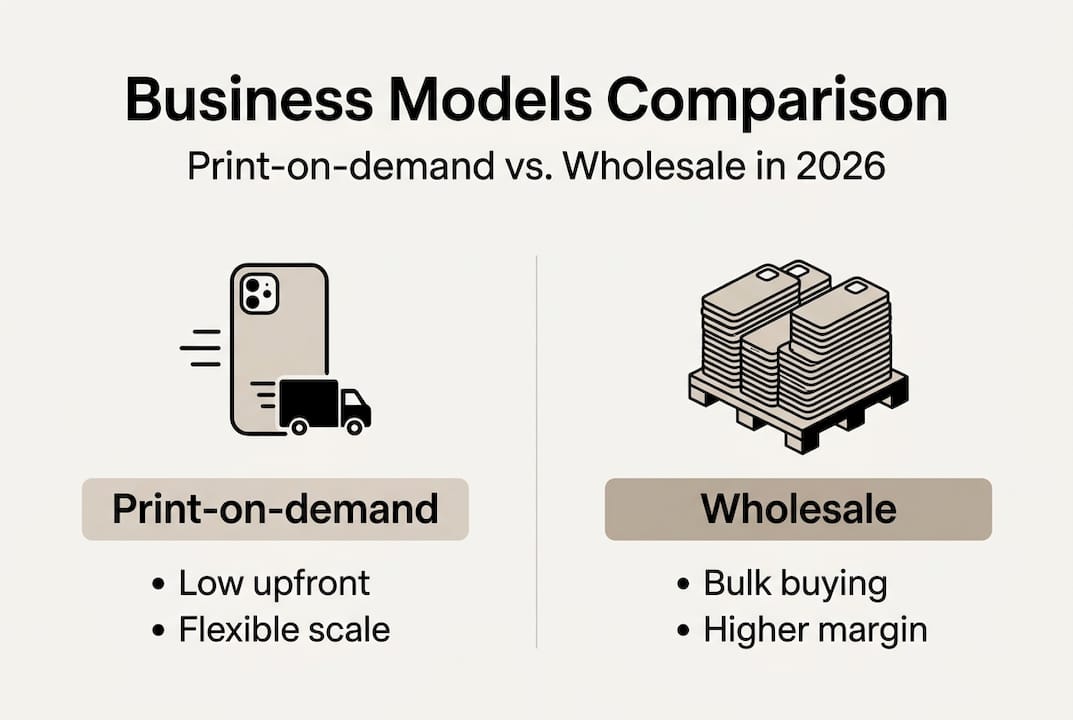
Strategic fit matters more than theoretical margins. Print-on-demand suits entrepreneurs testing markets or running side businesses. Wholesale requires sales skills and retail relationships. Custom production demands design confidence and marketing ability to move inventory quickly. Many successful operators start with print-on-demand, validate winning designs, then transition to custom production for those specific products.
Pro Tip: Start with print-on-demand for your first 10-20 designs. Once you identify 2-3 consistent sellers, consider custom production for just those designs while keeping others on-demand. This hybrid approach maximizes margins on proven products while minimizing risk on experimental designs.
Maximizing earnings: marketing and design strategies for 2026
Marketing effectiveness directly determines phone case business earnings. Social media advertising on Instagram and TikTok generates the highest returns in 2026, with successful campaigns achieving $2 to $5 revenue per dollar spent. Focus your creative on lifestyle shots showing cases in real scenarios rather than plain product photos. Video content outperforms static images by 60-80% in engagement and conversion rates.
Targeted social media ads and unique design styles increase conversion rates and average order values, making creative quality non-negotiable. Influencer partnerships provide another powerful channel. Micro-influencers with 10,000 to 50,000 followers often deliver better ROI than celebrities, charging $100 to $500 per post while maintaining authentic audience connections. Choose influencers whose aesthetic aligns with your designs for maximum impact.
Design trends in 2026 emphasize personalization and sustainability messaging. Customizable name or initial cases command 30-50% price premiums over generic designs. Eco-friendly materials attract environmentally conscious buyers willing to pay $5 to $10 more per case. Minimalist aesthetic continues dominating, with clean lines and subtle patterns outselling busy, complex designs.
Effective marketing tactics for 2026:
- Create short-form video content showing case durability and style
- Partner with 3-5 micro-influencers in your niche monthly
- Build email list offering 10% discount for first purchase
- Run retargeting campaigns to recover abandoned carts
- Develop user-generated content campaigns encouraging customer photos
Design elements that boost sales:
- Personalization options (names, initials, custom text)
- Seasonal or trending pop culture references
- Minimalist patterns with premium feel
- Eco-friendly or sustainable material messaging
- Complementary color palettes matching phone colors
Pricing strategy balances competitiveness with profitability. Research competitors selling similar quality and style, then position 10-15% below established brands or 20-30% above generic options. Bundle deals like “buy 2, get 15% off” increase average order value by $8 to $12. Free shipping thresholds at $35 or $50 encourage customers to add second items.
Customer engagement extends beyond initial purchase. Email sequences nurturing new buyers generate 25-35% repeat purchase rates within six months. Send design updates, exclusive previews, and seasonal promotions monthly. Loyalty programs offering points or discounts on third purchases build long-term value. Respond to customer service inquiries within 24 hours to maintain positive reviews and word-of-mouth referrals.
Pro Tip: Allocate 20-30% of revenue to marketing during your first year, then optimize based on channel performance. Track which platforms and creative styles generate lowest customer acquisition costs, then double down on winners while cutting underperformers.
Projecting earnings and managing costs effectively
Realistic income forecasting prevents financial surprises and guides strategic decisions. Start by calculating your average order value, typically $25 to $40 for phone case businesses. Multiply by projected monthly orders based on traffic and conversion rate. New stores average 0.5-2% conversion rates, while established brands reach 3-5%. If you drive 1,000 visitors monthly with 1.5% conversion, expect 15 orders generating $450 to $600 revenue.
Subtract costs systematically. Production and shipping consume $15 to $23 per order for print-on-demand. Platform fees take another $1.50 to $6 per sale. Marketing expenses divide into fixed monthly costs like software subscriptions and variable costs like advertising spend. Proper cost management and realistic sales projections are critical for sustainable phone case business earnings, requiring diligent tracking from launch.
Identify and monitor key expense categories monthly. Production costs should decrease as volume grows and you negotiate better rates or switch models. Shipping expenses optimize through carrier comparison and regional fulfillment centers. Marketing costs require constant evaluation, cutting channels delivering poor return while scaling successful ones. Platform fees remain relatively fixed, though switching from marketplaces to independent stores reduces this burden.
| Expense Category | Typical % of Revenue | Optimization Strategy |
|---|---|---|
| Production/fulfillment | 35-45% | Negotiate volume discounts, switch models at scale |
| Shipping | 10-15% | Compare carriers, offer local pickup options |
| Marketing/advertising | 20-30% | Focus on highest ROI channels, build organic reach |
| Platform fees | 3-15% | Move to independent store as volume grows |
| Software/tools | 2-5% | Use free tiers initially, upgrade only when necessary |
Cost control methods:
- Review all subscriptions quarterly, canceling unused services
- Test advertising campaigns at $5-$10 daily before scaling
- Negotiate payment terms with suppliers after establishing relationship
- Automate repetitive tasks like order processing and email marketing
- Outsource specialized tasks only when your time value exceeds contractor cost
Adjust strategies based on profit performance data. If margins fall below 25%, either raise prices, reduce costs, or improve conversion rates. Track metrics weekly during first six months, then monthly once stable. Compare actual performance against projections, investigating significant variances. Successful businesses pivot quickly when data reveals problems or opportunities.
Pro Tip: Build a simple spreadsheet tracking revenue, costs by category, and net profit weekly. This visibility helps you spot trends early and make data-driven decisions rather than emotional reactions to short-term fluctuations.
Enhance your phone case business with professional mockups
Professional mockups dramatically improve conversion rates by helping customers visualize your designs on actual devices. Quality product photography increases perceived value, justifying premium pricing and reducing return rates. Bettermockups offers specialized collections designed specifically for phone case businesses, including photorealistic templates and animated video mockups that bring designs to life.
Explore the video mockups collection to create engaging social media content that stops scrollers and drives clicks. The iPhone case mockups collection provides templates for every iPhone model, ensuring your designs appear current and professional. New to mockups? The mockups usage guide walks you through customization steps, helping you create stunning visuals without design experience.
What factors most influence phone case business earnings?
What factors most influence phone case business earnings?
Design quality and uniqueness drive initial sales, while marketing effectiveness determines how many potential customers see your products. Cost management directly impacts profit margins, with successful businesses maintaining expenses below 70% of revenue. Customer service quality influences repeat purchases and word-of-mouth referrals, creating compounding growth over time. Platform choice affects both fees and audience reach, requiring careful evaluation of trade-offs.
How much can a new print-on-demand phone case business expect to earn in its first year?
Most new print-on-demand phone case businesses earn $3,000 to $15,000 in their first year after expenses, though results vary widely based on effort and strategy. Part-time operators typically net $300 to $800 monthly once established, while full-time entrepreneurs reach $1,500 to $3,000 monthly by month six. Success requires consistent marketing, design iteration based on sales data, and patience during the initial three to four months of minimal sales.
What are common cost pitfalls that reduce phone case store profits?
Overspending on paid advertising before validating organic demand wastes budgets and creates unsustainable customer acquisition costs. Pricing too low to compete with established brands erodes margins without necessarily increasing sales volume. Using expensive fulfillment services when cheaper alternatives exist unnecessarily inflates per-order costs. Paying for premium software subscriptions before reaching scale adds fixed costs that destroy profitability at low volumes. Neglecting to negotiate supplier rates after establishing consistent order volume leaves money on the table.
Which marketing tactics best boost phone case sales and earnings in 2026?
Short-form video content on TikTok and Instagram Reels generates the highest engagement and conversion rates in 2026, particularly when showcasing lifestyle use rather than static product shots. Micro-influencer partnerships deliver strong ROI for modest budgets, providing authentic endorsements to targeted audiences. User-generated content campaigns encourage customers to share photos, creating social proof while reducing content creation costs. Email marketing to existing customers drives repeat purchases at minimal cost, often generating 30-40% of revenue for established stores.
How can I scale my phone case business profitably over time?
Diversify your design portfolio by testing new styles monthly while keeping proven sellers active. Optimize costs by transitioning best-selling designs from print-on-demand to custom production as volume justifies inventory investment. Expand marketing channels gradually, mastering one platform before adding others to avoid spreading resources too thin. Build systems and automation for repetitive tasks, freeing time for strategic activities like design development and partnership outreach. Make decisions based on sales data rather than personal preferences, cutting underperforming products quickly while doubling down on winners.


