

You're managing 200+ phone case listings across Etsy, Amazon, and TikTok Shop. Each one uses slightly different fonts, inconsistent color treatments, and mockup styles that don't quite match. Customers land on your store and something feels off, even if they can't articulate it. That disconnect is exactly what branding guidelines solve: a documented system that keeps every visual and verbal element of your business aligned, so your brand looks intentional rather than improvised.
Brand guidelines act as the rulebook for how your business presents itself everywhere, from product mockups to social ads to packaging inserts. They define your logo usage, typography, color palette, imagery style, and tone of voice. For POD sellers building real brands (not just pushing listings), this consistency is what separates a forgettable shop from one customers actually remember. When your mockups, your Instagram grid, and your thank-you cards all speak the same visual language, trust compounds with every touchpoint.
This guide breaks down exactly what brand guidelines include, why they matter for business consistency, and how to build your own style guide, whether you're codifying an existing look or starting from scratch. We'll cover the core elements, walk through real examples, and give you a practical framework you can apply to your own shop today.
What branding guidelines are and what they do
Brand guidelines are a documented reference system that defines how your business looks, sounds, and presents itself across every customer interaction. Think of them as the instruction manual for your brand identity. When you publish a TikTok Shop listing, design a product mockup, write a customer email, or create an Instagram story, your brand guidelines tell you exactly which fonts to use, which colors are on-brand, how your logo should appear, and what tone of voice matches your business. This documentation removes guesswork and keeps your brand recognizable whether someone sees your work on Etsy, Amazon, or a sponsored ad.
The documented elements brand guidelines define
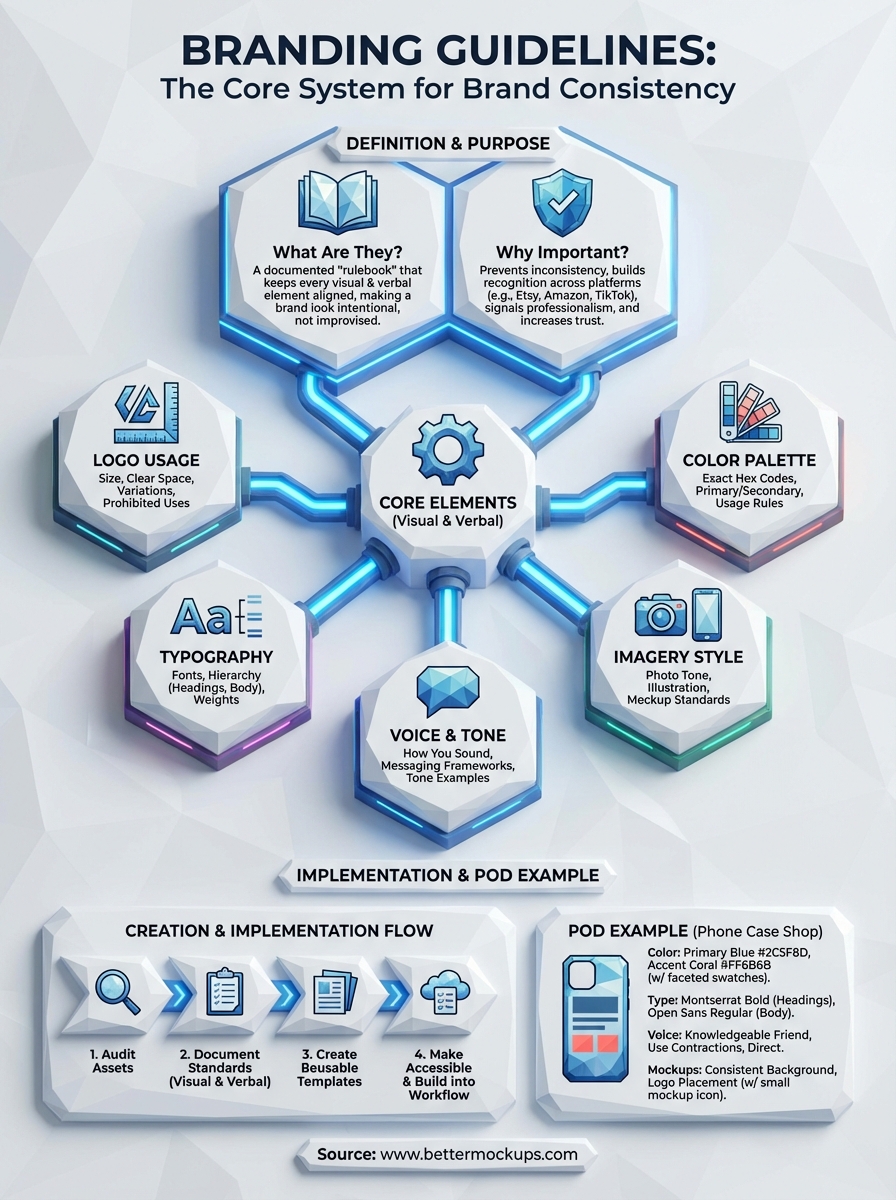
Brand guidelines typically include visual standards and verbal standards in a single document or set of resources. The visual section covers your logo (including size requirements, clear space rules, acceptable color variations, and prohibited uses), your color palette (with exact hex codes, RGB values, and Pantone references), your typography system (primary and secondary fonts, acceptable weights, hierarchy rules), and your imagery style (photography tone, illustration approach, mockup presentation standards). The verbal section defines your brand voice, approved messaging frameworks, tagline usage, and sometimes even customer service response templates.

You'll also find application examples showing correct and incorrect usage. A mockup creator, for instance, might include examples of proper product staging, background treatments, and text overlay standards. These practical demonstrations matter more than abstract rules because they show you what good execution actually looks like in context.
How brand guidelines function in practice
Brand guidelines act as a decision-making filter for anyone creating content under your business name. When you're designing a new phone case listing and wondering whether to use that trendy gradient background, your brand guidelines give you an immediate answer based on your established imagery standards. When a freelance designer you hired for social media asks what fonts are approved, you send them the typography section instead of starting from scratch. This documented system scales your brand without requiring your personal approval on every creative decision.
Brand guidelines transform subjective preference into objective standard, so "Does this feel right?" becomes "Does this match our documented system?"
Guidelines also protect your brand from drift. Without documentation, your color palette slowly shifts as you eyeball colors in Canva or Photoshop. Your logo gets stretched, condensed, or placed on backgrounds that kill its visibility. Your product mockups start looking like they represent five different businesses instead of one cohesive brand. The document holds the line so that a listing you publish today looks intentionally related to one you published six months ago, even as your design skills improve or your team expands.
What brand guidelines control across platforms
Brand guidelines govern everything your audience sees and reads. This includes obvious applications like your Shopify header, your Etsy banner, and your product mockups, but it also extends to packaging inserts, email signatures, invoice templates, social media bios, and even the way you write product descriptions. Every touchpoint either reinforces or undermines your brand, and guidelines ensure the former.
For POD sellers managing listings across multiple marketplaces, brand guidelines create visual continuity that helps customers recognize your work regardless of where they find it. Your Amazon storefront, your TikTok Shop, and your standalone website might have different technical requirements and layout constraints, but they can still share the same fonts, colors, logo treatment, and photography style. That consistency is what makes a collection of listings feel like an actual brand rather than a loosely related assortment of products.
Understanding what branding guidelines are is the foundation, but their real value emerges when you see how they prevent the consistency problems that quietly damage customer trust and platform performance.
Why branding guidelines matter for consistency and trust
Inconsistent branding costs you money in ways that don't show up as line items on your P&L. When your product mockups use three different fonts across your catalog, when your Instagram grid doesn't match your Etsy banner, when your color palette shifts from listing to listing, customers register the mismatch subconsciously. They don't think "this brand has inconsistent guidelines," they think "something feels off," and that feeling translates into fewer add-to-carts, lower conversion rates, and reduced repeat purchase intent. Brand guidelines solve this by creating visual and verbal consistency that builds recognition and trust with every exposure.
How consistency creates recognition
Recognition is a conversion advantage that compounds over time. When a customer sees your TikTok Shop listing, then encounters your Instagram ad two days later, then lands on your Etsy storefront the following week, consistent branding makes those three exposures feel like one continuous relationship rather than three disconnected encounters. Your brain processes familiar visual patterns faster than unfamiliar ones, so a customer who recognizes your brand from previous exposure converts faster because they've already cleared the initial trust barrier.
POD sellers competing in saturated markets need every edge, and brand recognition is one you control completely. Your competitor's phone case might use the same manufacturer and similar design style, but if their mockups, social presence, and storefront lack visual coherence, they're starting the trust-building process from zero with every new customer interaction. Your documented guidelines ensure that's not your problem.
Why trust depends on perceived professionalism
Trust forms when execution matches expectation. A customer browsing your catalog expects a business that looks intentional to behave intentionally. When your branding is consistent (same fonts, same color treatments, same mockup quality standards), the subconscious message is that you run a real operation with systems and standards. When your branding is inconsistent, the subconscious message is that you're winging it, and customers hesitate before buying from someone who appears to be improvising.
Documented brand guidelines signal operational maturity, and customers trust mature operations more than they trust businesses that look like side hustles.
This perception directly impacts review quality and return rates. Customers who trust your brand before purchase are more forgiving when minor issues occur and more likely to interpret ambiguity in your favor. Understanding what are branding guidelines and implementing them transforms your business from a collection of listings into a credible brand customers feel confident recommending.
What to include in branding guidelines
Your brand guidelines document should cover both visual and verbal elements in enough detail that someone unfamiliar with your business can make brand-aligned decisions without asking for clarification. The scope depends on your operation's complexity, but even a single-person POD shop benefits from documenting the fundamentals. At minimum, you need logo standards, a defined color palette, typography rules, imagery guidelines, and voice/tone direction. These five components form the foundation that keeps your listings, social content, and customer communications visually and verbally consistent across every platform where you sell.
Visual identity elements
Your logo section defines acceptable usage scenarios and prohibited modifications. This includes approved logo variations (full color, single color, reversed), minimum size requirements (so it stays legible in small applications like favicon or profile photos), clear space rules (the protected area around your logo that must remain empty), and explicit don'ts (stretching, rotating, recoloring, placing on busy backgrounds). Document your primary and secondary color palettes with exact hex codes, RGB values for screen use, and CMYK values if you ever print packaging or business cards. Include guidance on when to use each color and how much of your palette should appear in any given design.

Typography standards specify your font choices and hierarchy rules. Define your primary typeface for headings, your secondary typeface for body text, acceptable font weights, and size relationships. If you're using free Google Fonts, list the exact font names so anyone accessing your guidelines can load the correct files. Your imagery section establishes the visual style for product mockups, lifestyle photography, and graphics, covering background treatments, lighting preferences, composition standards, and whether you use photography, illustrations, or a mix.
Voice and messaging standards
Brand voice guidelines define how your business sounds in writing. Specify whether your tone is professional, conversational, playful, or technical. Include examples of phrases that match your voice and phrases that don't. This section ensures your product descriptions, customer service emails, and social captions all feel like they come from the same business. For POD sellers writing hundreds of listings, documented voice standards prevent your catalog from sounding like it was written by five different people.
Understanding what are branding guidelines means recognizing that verbal consistency matters as much as visual consistency for building brand recognition.
Application examples and usage rules
Show correct and incorrect applications of your guidelines in real contexts. Include mockup examples demonstrating proper logo placement on product images, social media templates showing approved layouts, and email signature examples. Create a do's and don'ts section with side-by-side comparisons: acceptable logo backgrounds versus prohibited ones, proper color combinations versus clashing pairs, correct typography hierarchy versus confusing text treatments. These visual demonstrations communicate standards faster than written rules alone.
Branding guidelines vs brand strategy and style guides
Brand guidelines, brand strategy, and style guides overlap in purpose but serve different functions in your business operations. The confusion between these terms is common because they all relate to how your business presents itself, but understanding what are branding guidelines versus what constitutes strategy or style documentation helps you build the right tools for the right problems. Brand strategy answers why your business exists and who it serves, while brand guidelines document how that strategy manifests visually and verbally. Style guides focus narrowly on editorial and design standards, often as a subset of broader brand guidelines.
How brand strategy differs from branding guidelines
Brand strategy defines your positioning, target audience, value proposition, and competitive differentiation before any visual or verbal identity gets created. This strategic work answers questions like "Why should customers choose us over competitors?" and "What emotional outcome do we deliver?" Your brand strategy might conclude that you serve POD sellers who value accuracy over speed, that your tone should be direct rather than aspirational, and that your visual identity should communicate precision. Those strategic decisions then inform what goes into your brand guidelines.
Brand guidelines execute the strategy through documented standards. Once you know your positioning requires a tone that's direct and professional, your guidelines specify exactly which fonts convey that tone, which color palette supports it, and what imagery style aligns with it. Strategy is the blueprint, guidelines are the construction manual. You don't revisit your strategy every time you create a mockup, but you reference your guidelines constantly.
Brand strategy tells you where you're going, brand guidelines tell you how to get there without getting lost.
Why style guides and brand guidelines overlap but aren't identical
Style guides typically focus on editorial standards and design consistency for content production. A style guide might specify whether you use Oxford commas, how you format product titles, preferred terminology for technical features, and design templates for social media posts. Brand guidelines include these elements but expand to cover your complete brand identity system, including logo usage, color theory, typography hierarchy, and voice principles that inform the style guide rules.
Many businesses combine both into a single document because the audience overlaps (anyone creating content under your brand name) and separating them creates version control headaches. Your brand guidelines might include a style guide section, or your style guide might reference brand guidelines for visual standards. The distinction matters less than ensuring you have documented standards that cover both what your brand looks like and how it communicates, accessible to anyone who needs them.
How to create branding guidelines step by step
Building brand guidelines doesn't require a design agency or months of strategic planning. You can create functional documentation in a few focused sessions by working through your existing brand elements systematically, then documenting the standards you want to maintain going forward. The process works whether you're codifying a look you've been using inconsistently or defining a brand identity from scratch. Start with what already exists, identify what's working, eliminate what isn't, then document the decisions so future creative work follows a clear system rather than reinventing standards with every new listing or social post.
Audit your current brand elements
Collect every branded asset you've published across all platforms including product mockups, social media graphics, email templates, storefront banners, packaging inserts, and any marketing materials. Spread them out (digitally or physically) and look for patterns in your color usage, typography choices, logo treatments, and imagery style. You'll likely find accidental consistency in some areas and chaotic variation in others. Mark which elements feel most aligned with how you want your brand perceived, then note which assets look like they belong to different businesses entirely.
This audit reveals your starting point and shows you which standards you're already following (even if you haven't documented them) versus which elements need deliberate definition. If 80% of your recent mockups use the same two fonts, those fonts are candidates for your official typography system. If your color palette shifts wildly from listing to listing, you need to choose and document a fixed palette.
Document your visual standards first
Create a simple document that defines your logo usage rules, color palette, and typography system with enough specificity that someone else could apply these standards without asking questions. For your logo, specify minimum sizes, required clear space around it, acceptable color variations, and surfaces where it should never appear. List your color palette with exact hex codes (you can use a browser color picker on existing assets to capture the values you've been using inconsistently).
Typography documentation should name your exact fonts with usage rules for each: which font handles headings, which handles body text, acceptable weights, and size relationships. If you're using system fonts or Google Fonts, include download links or installation instructions. Add visual examples showing each element in use so the standards feel concrete rather than abstract.
Define your voice and verbal identity
Your brand voice determines how you sound in product descriptions, customer emails, and social captions. Write three to five adjectives that describe your desired tone (direct, helpful, professional, approachable), then create example phrases that embody this voice and counter-examples that don't. This section answers what are branding guidelines on the verbal side, giving anyone writing for your brand a clear reference for maintaining tonal consistency.
Include practical applications like whether you use contractions, how you address customers, technical terminology standards, and sentence structure preferences. A simple table comparing approved phrases versus off-brand alternatives communicates voice standards faster than paragraphs of abstract guidance.
Documented voice standards prevent your catalog from sounding like content written by different people, which undermines brand cohesion as much as visual inconsistency does.
Create templates and examples
Transform your documented standards into reusable templates for common applications like product mockups, social media posts, email signatures, and promotional graphics. These templates encode your guidelines into ready-to-use formats that make compliance effortless. When you or a team member needs to create a new listing, starting from a template ensures brand consistency by default rather than requiring conscious reference to your guidelines document every time.
A simple branding guidelines example to follow
A functional brand guidelines document doesn't need to be 50 pages with custom illustrations and agency-level production values. You can create a working reference in a simple Google Doc or PDF that covers the essentials: logo usage, color palette, typography, imagery standards, and voice guidelines. The example below demonstrates what minimal but complete guidelines look like for a POD phone case business, showing exactly how much detail you need to maintain consistency without overcomplicating the documentation.
Core visual standards in action
Your logo section specifies the basics without requiring design school knowledge. Document your logo file names and where to access them (Dropbox folder, Google Drive, asset library), then define minimum size requirements like "never smaller than 120px wide for digital use" and clear space rules like "maintain empty space around logo equal to the height of the letter in your brand name." List your exact color palette with hex codes: Primary Brand Blue (#2C5F8D), Accent Coral (#FF6B6B), Neutral Gray (#4A4A4A), Background Cream (#FAF8F5). State which colors pair together and which combinations to avoid.
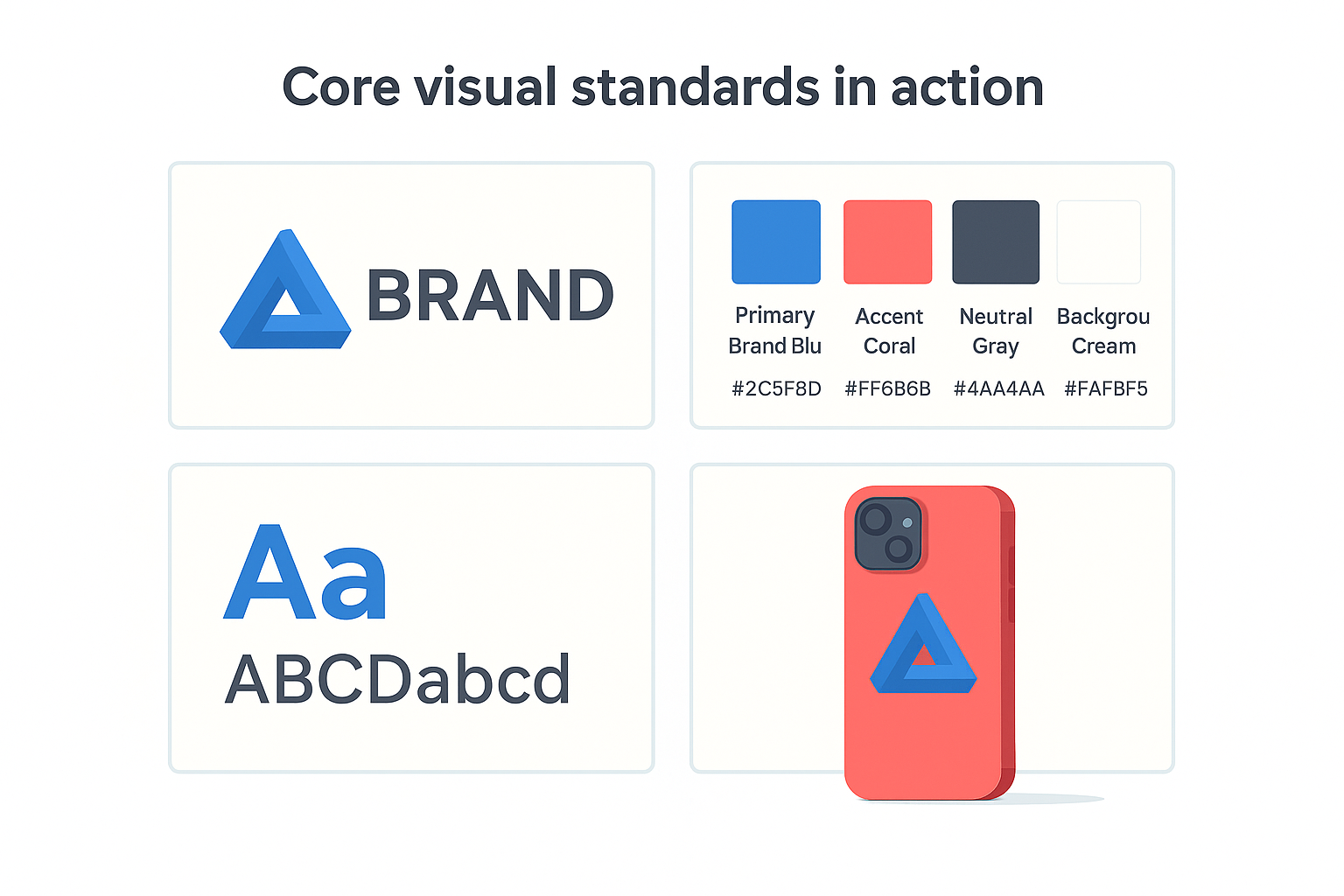
Typography standards name your specific fonts with hierarchy rules. Example: "Montserrat Bold for all headings, sizes 24px-48px. Open Sans Regular for body text, 16px. Never mix more than these two typefaces in a single design. Headings always use Primary Brand Blue or Neutral Gray, never Accent Coral." This level of specificity prevents creative interpretation that leads to inconsistency.
Voice and application rules
Your voice section defines how you sound across all written content with concrete examples rather than abstract adjectives. Instead of just saying "professional but approachable," show what that means: "We write like a knowledgeable friend, not a corporate brand. We use contractions (you're, we'll, it's). We address customers as 'you' and never 'clients' or 'users.' We explain technical details without dumbing them down. Example product description: 'This case fits iPhone 16 Pro with precise camera cutouts and MagSafe compatibility' NOT 'Protect your precious device with our amazing premium quality case!'"
Understanding what are branding guidelines through examples makes implementation immediate because you see exactly how standards translate into real applications rather than theoretical principles.
Application examples show your standards in context. Include mockup templates with notes: "Product images always use Background Cream backdrop, never pure white. Logo appears in bottom right corner at 10% opacity. Design previews center on case with 40px padding on all sides." These practical demonstrations eliminate guesswork when you create your next listing or hire freelance help.
How to share, enforce, and update your guidelines
Brand guidelines only work if people can access them when making creative decisions. A beautifully documented style guide sitting in a forgotten Google Drive folder doesn't prevent inconsistency, it just creates the illusion of having standards. Your guidelines need to live where your work happens, whether that's a pinned Notion page, a shared PDF in your asset folder, or a printed reference sheet next to your workspace. The easier you make it to check your standards, the more likely you'll actually follow them when designing that next phone case mockup or writing that product description.
Making your guidelines accessible to anyone who creates content
Store your brand guidelines in a cloud-accessible format like Google Docs, Notion, or a simple PDF saved in Dropbox or Google Drive. Send the link to anyone who creates content for your business (freelance designers, virtual assistants, social media managers) before they start their first project. Pin the guidelines document in your project management system if you use one, or save it as a browser bookmark so you can reference it instantly when questions arise during mockup creation or listing optimization.
If you work with multiple freelancers or team members, create a stripped-down quick reference version that fits on a single page with just your color codes, font names, logo file locations, and voice examples. This condensed guide serves as the everyday reference while your complete documentation remains available for complex questions.
Brand guidelines you reference constantly beat comprehensive documentation you never open, so optimize for accessibility over completeness.
Building enforcement into your workflow
Enforcement happens through templates and checklists, not policing. Create mockup templates with your colors and fonts already loaded, social media post templates sized correctly with proper logo placement, and email signature templates that match your typography standards. When starting from an approved template becomes easier than starting from scratch, compliance follows naturally without requiring constant guideline consultation.
Add a simple brand checklist to your pre-publish routine: correct fonts used, colors match hex codes, logo meets size/spacing rules, voice matches documented tone. This quality gate takes 30 seconds and prevents the gradual drift that turns intentional branding into accidental inconsistency over six months.
When and how to update your documentation
Review your brand guidelines every six months or when you notice repeated questions about how to handle specific scenarios your current documentation doesn't address. Update your guidelines when you deliberately evolve your visual identity (new color palette, updated logo), not every time you feel like experimenting. Understanding what are branding guidelines means recognizing they document your established system, not your creative impulses.
Version your updates with dates and change notes so anyone using your guidelines knows they're referencing current standards. When you update fonts or colors, simultaneously update all your templates so old versions don't circulate and create confusion.
Final takeaways
Understanding what are branding guidelines gives you the foundation to build a recognizable, trustworthy POD business that customers remember and return to. Your documented guidelines transform subjective creative decisions into objective standards, preventing the visual and verbal inconsistency that quietly undermines customer confidence across your Etsy shop, Amazon storefront, and TikTok listings. The five core elements (logo standards, color palette, typography, imagery guidelines, and voice direction) form the system that makes 200+ listings feel like one cohesive brand instead of a scattered catalog.
Brand guidelines only deliver value when you actually use them. Start by documenting what you're already doing (even inconsistently), define your standards, then build those standards into templates that make compliance automatic rather than optional. Your mockup quality directly reflects your brand standards, so using production-accurate phone case mockups ensures every listing reinforces rather than contradicts your documented guidelines.


