

If you're evaluating Gooten print on demand as a fulfillment partner for your phone case business, you're probably comparing it against providers you already know, Printful, Printify, maybe Gooten's own lesser-known competitors. The decision matters more than most sellers realize, because your fulfillment provider determines what your customer actually receives, and that has a direct impact on whether your listings build trust or quietly erode it.
Gooten operates as a white-label print-on-demand network, routing orders to a global web of manufacturing partners. That model comes with real advantages, and some tradeoffs worth understanding before you commit. This article breaks down Gooten's product catalog, platform integrations, pricing structure, and what actual sellers are saying in reviews, so you can make an informed decision based on specifics, not marketing copy.
One thing worth noting upfront: no matter which POD provider you choose, the accuracy of your listing mockups still depends on you. At Bettermockups, we build phone case mockup templates matched to real manufactured specs, so if Gooten (or any provider) is on your shortlist, your listings can reflect what actually ships.
Why sellers consider Gooten for print on demand
Gooten print on demand attracts sellers for a few concrete reasons that go beyond surface-level appeal. The platform sits between Printful's vertically integrated model and Printify's open marketplace, giving you a managed network of vetted manufacturing partners without locking you into a single production facility. That structure matters when you're scaling and need consistent output across multiple product lines without rebuilding your fulfillment setup from scratch.
A cost structure built for volume
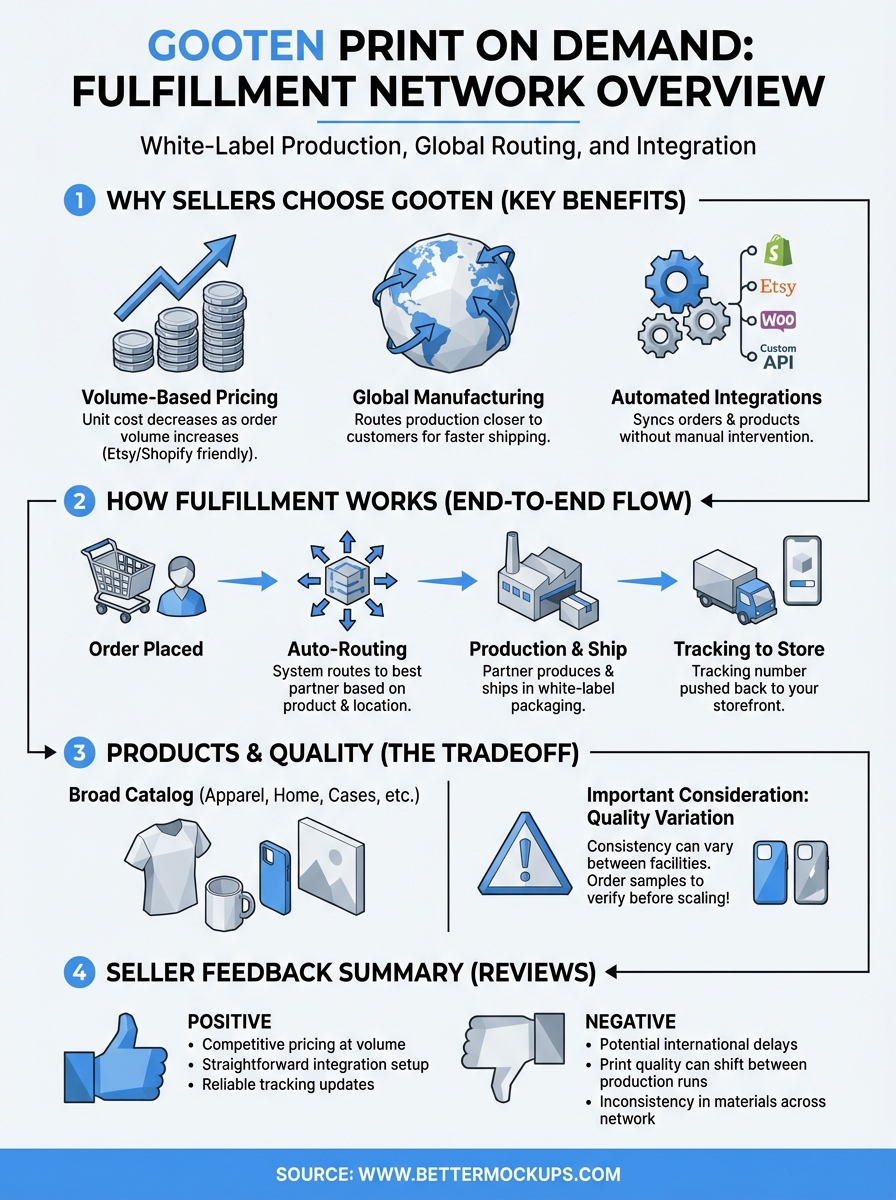
One of the primary reasons sellers test Gooten is pricing that gets more competitive as order volume increases. Unlike flat-rate platforms, Gooten's model factors in your production history, which means the unit cost you see on day one isn't necessarily the cost you're locked into long-term. Sellers running high-volume Etsy or Shopify stores often find Gooten's tiered approach gives them better margin headroom than providers with fixed pricing.
Your actual savings depend on product type and fulfillment location, so running the numbers on your specific catalog before committing is worth the time.
The difference between two providers at low volume can look minor, but at 500 orders a month, even a small per-unit gap compounds into a meaningful margin difference.
Global manufacturing network
Gooten routes production to manufacturing partners across multiple countries, which directly affects shipping times and international reach for your store. If you sell to customers in Europe or Australia, routing production closer to them reduces transit time and cuts shipping costs. That geographic flexibility is a real operational advantage if your customer base has grown beyond the US market.
The tradeoff is that production quality can vary slightly depending on which facility fulfills a given order. Most sellers who run into inconsistency issues trace them back to this distributed model, which is worth factoring into your evaluation before you commit.
How Gooten fulfillment works end to end
When a customer places an order in your store, Gooten print on demand pulls the order details automatically and routes production to the most appropriate manufacturing partner in its network based on product type and location. You don't manually assign fulfillment. The system handles routing in the background, which keeps your operational overhead low once your setup is complete.
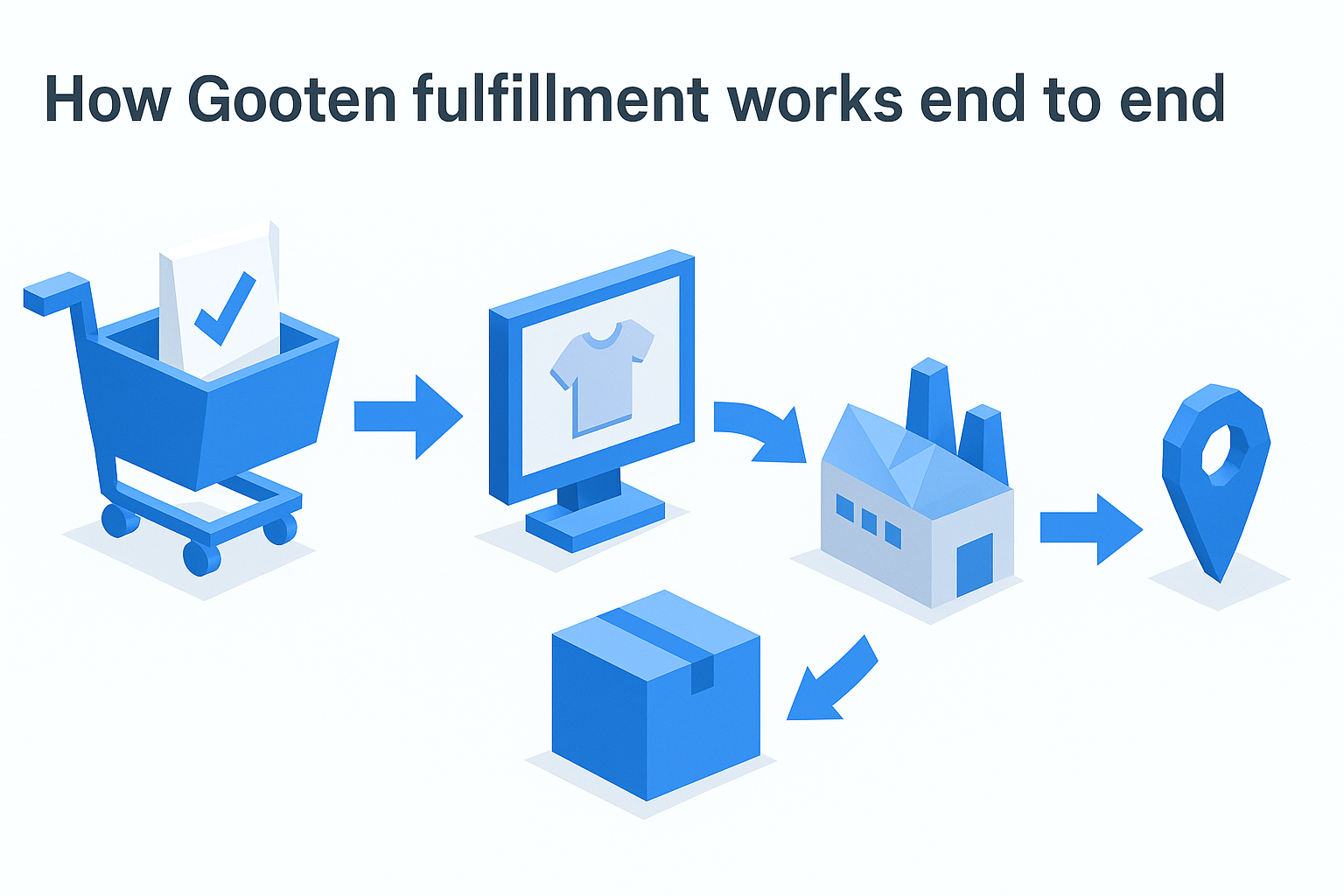
The less time you spend managing individual orders, the more time you have to optimize listings and grow your catalog.
Order routing and production
Gooten evaluates product type, print specifications, and fulfillment geography when assigning each order to a manufacturing partner. Once assigned, the partner produces the item and ships it under your brand name. White-label packaging means your customer sees your store, not Gooten's, which supports the brand experience you're building.
Shipping and tracking
After production, Gooten generates a tracking number and pushes it back to your storefront automatically. Delivery timelines depend on which facility fulfilled the order and where your customer is located. International orders routed to regional facilities typically arrive faster than those shipped from a single domestic hub, which is one of the clearest practical benefits of a distributed production network.
Products, customization, and quality expectations
Gooten print on demand covers a broad product catalog that goes well beyond phone cases, including apparel, home goods, wall art, and accessories. For phone case sellers specifically, the catalog depth matters less than the accuracy of what ships, and that's where you need to look closely before publishing your first listings.
Phone cases and accessories
Gooten offers cases for a range of iPhone and Samsung models, with options across different case styles. Product specifications, including edge profiles and finish types, vary depending on which manufacturing partner produces the order. That variability means the mockup you publish may not match what your customer opens.
If your mockups aren't built to match your actual manufacturer's specs, you're setting up your listings to fail before a single order ships.
What quality actually looks like in practice
Print quality on Gooten orders is generally competitive with other major POD networks, but consistency is the real variable to test. Sellers running phone case catalogs frequently report that print alignment and finish accuracy can shift slightly between production runs, particularly on orders routed to different regional facilities. Ordering samples across multiple fulfillment windows before scaling a product line gives you a realistic picture of what your customers will consistently receive.
Integrations, workflows, and scaling features
Gooten print on demand connects directly to major ecommerce platforms, giving you automated order syncing without manual intervention. Once connected, orders flow from your storefront to Gooten's production network automatically, keeping your time focused on catalog growth rather than individual order management.
Platform connections
Gooten supports direct integrations with the platforms most active POD sellers rely on. Shopify and Etsy are the primary native connections, with WooCommerce available for self-hosted stores. Product syncing maps your listings to production-ready SKUs through Gooten's dashboard, so your catalog stays aligned without manual updates every time you add a new design.
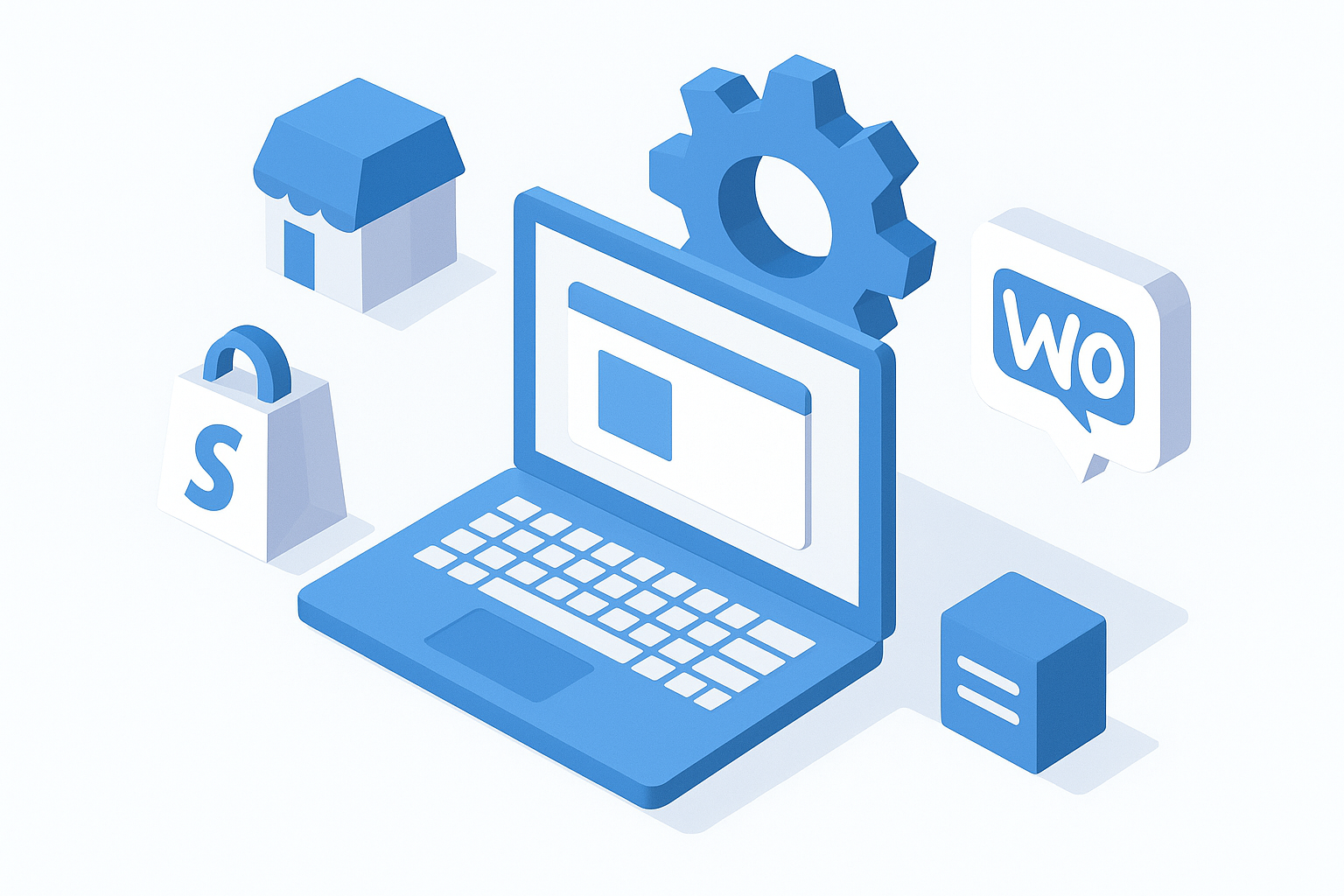
Supported platform integrations include:
- Shopify
- Etsy
- WooCommerce
- Custom API connections
API access and automation
When your catalog grows into hundreds of listings, manual dashboard management becomes a bottleneck. Gooten's API access lets you build custom workflows that connect your design pipeline, inventory tracking, and order routing in one place. Sellers using the API can automate product creation at scale without being limited by what the native dashboard supports.
The more of your workflow you automate, the more time you have to add listings and optimize the ones already live.
Reviews, reliability, and common issues to watch
Seller feedback on Gooten print on demand follows a consistent pattern: the platform works well when order volume stays manageable, but reliability becomes the central concern as stores scale. Understanding what real sellers report before you commit saves you from discovering the same problems after your catalog is already live.
What sellers report in reviews
Positive reviews tend to highlight Gooten's competitive pricing and the convenience of automated order routing. Sellers running multi-platform stores appreciate that the integration setup is straightforward and that tracking information pushes back to their storefronts reliably. For sellers at moderate order volumes, the experience is generally stable.
The gap between what sellers expect and what they get almost always traces back to production inconsistency, not platform functionality.
Where reliability breaks down
Negative reviews cluster around two issues: shipping delays on international orders and variation in print quality between fulfillment runs. Both problems connect directly to the distributed manufacturing model. When different facilities produce the same product, slight differences in print calibration and materials can surface. Sellers who order samples before scaling a product line consistently report fewer surprises than those who go live immediately.
Final takeaways
Gooten print on demand is a solid option for sellers who need a cost-competitive, globally distributed fulfillment network that connects directly to Shopify, Etsy, and WooCommerce. The platform performs best when you approach it methodically: order samples before scaling, test multiple fulfillment windows, and treat production consistency as something you verify rather than assume.
The distributed manufacturing model is both Gooten's biggest advantage and its main limitation. Geographic routing saves you on shipping costs and delivery times, but it introduces variability you have to account for in your listings. If your mockups don't accurately represent the product your specific manufacturer ships, the best fulfillment setup in the world still produces refunds and review damage.
That's the part only you can control. If you're building a phone case catalog that needs to match what actually ships, production-accurate phone case mockup templates are the place to start.


